- Home »
- Catalog »
- Crate Engines and Builder Kits »
- Short Blocks (Assembled and Unassembled Kits) »
- Short Blocks (Assembled) »
- 400 Block
400 Block
Pontiac V8 400 Block
Pick the Stroke First — 400 Block for Pontiac V8s
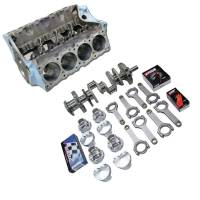
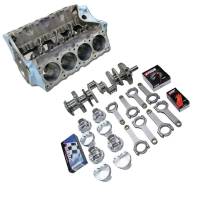
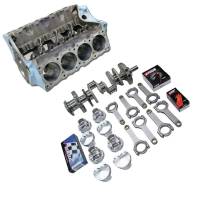
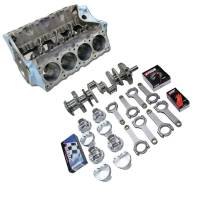
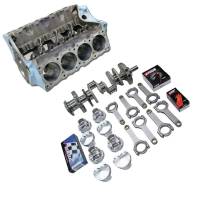
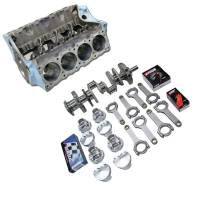
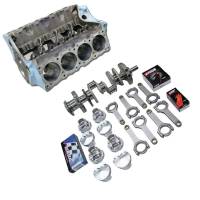
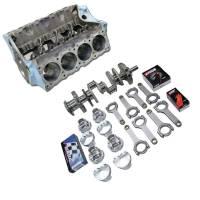
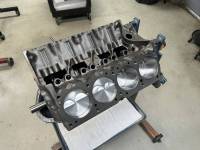
The 400 is the Pontiac block most people are actually holding, and an assembled 400 short block turns it into a finished bottom end: machined block, crank, rods, pistons, rings and bearings installed and internally balanced, ready for your cam, heads and intake. Stroke is what separates the choices, and it is the single biggest decision on this page.
Butler builds this block two ways. Budget Short Blocks use the later 557 casting at stock or near-stock stroke, and Custom Short Blocks use a long-rod rotating assembly with H-beam rods in strokes from 3.750" to 4.500", covering 406-412 through 487-495 cu. in.
Browse 400 Block Products

Popular Brands:
More About 400 Block
1. The Stroke Ladder on a 400 Block
Every assembled 400 short block is the same block with a different crank under it. Displacement follows the stroke and the bore you clean up at.
| 3.750" stroke, 406-412 cu. in. | stock stroke with new parts, and the safest option on a marginal core. |
| 4.000" stroke, 433-440 cu. in. | the classic first step. More torque everywhere, no exotic parts. |
| 4.210" and 4.250" stroke, 455-462 and 460-467 cu. in. | the two most popular Butler strokers, where a 400-block car starts acting like a big-inch Pontiac. |
| 4.350" and 4.500" stroke, 471-478 and 487-495 cu. in. | maximum cubic inches from a factory 400. Butler recommends 4-bolt billet main caps on the 4.500" stroke. |
2. The 557 Casting Rule
This is the one thing that catches 400 owners, and it is worth reading before you order anything.
| Thinner main webbing | Butler does not recommend a long stroke on blocks with casting numbers ending in 557, and suggests limiting those to 4.000" stroke and under 500 hp. |
| Built as a budget package on purpose | the 557 Budget Short Blocks are offered at 3.750" and 4.000" stroke only, 406-412 and 433-440 cu. in. |
| Check the casting first | if your block ends in 557 and the plan calls for 4.250" or more, the honest answer is a different core, not a bigger crank. |
3. Bore, Pistons and What Comes Assembled
Bore is chosen after the block is inspected. Butler starts options at .030" over so the cylinders clean up and the rings seat within spec.
| Common bores | 4.150", 4.155", 4.160" and 4.181". Larger is available on a block that will support it. |
| Piston style | choose flat top, dish or dome. Add your head casting or chamber cc at checkout and Butler confirms the compression ratio before ordering pistons. |
| Early blocks with deep valve notches | Butler stocks Ross flat tops with an offset ring support for early 400 blocks and for nitrous or boost use. |
| Assembled and balanced | both families are internally balanced, assembled by a Butler engine specialist and shipped on a reusable engine cradle. |
| Rotating assembly | cast or forged crank, Total Seal file-fit rings, performance rod and main bearings and a Viton rear main seal. Budget builds run 6.625" I-beam rods at 3.750" stroke; custom builds use a long-rod H-beam assembly. |
| Block prep | cleaned, magnafluxed, sonic tested, deburred, bored and honed with a torque plate, line honed with ARP main studs, deck squared, cam bearings and freeze plugs installed. |
Decide the cam and cylinder heads at the same time you pick the stroke. The piston that gets ordered has to suit all three.
Not sure what your Pontiac needs?
Email our tech team at tech@butlerperformance.com. Tell us your engine, heads, car, and power goal, and we will put the parts together as one combination that works.