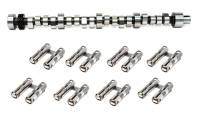
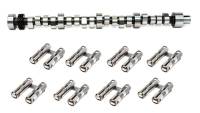
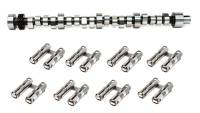
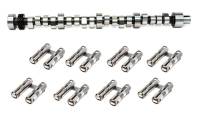
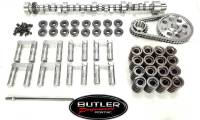
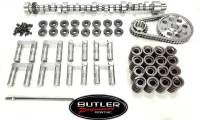
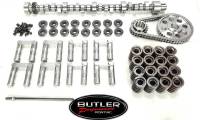
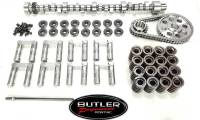
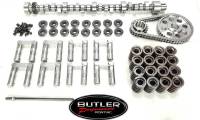
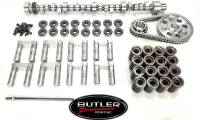
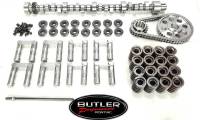
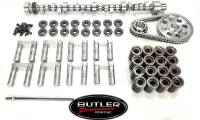
Pontiac V8 Hi-Torq Aggressive Series Hydraulic Roller Cams
The Top of the Hydraulic Roller Ladder — Hi-Torq Aggressive Series Hydraulic Roller Cams for Pontiac V8s
The Hi-Torq Aggressive Series is the largest hydraulic roller family Butler grinds for the Pontiac V8. Three duration steps from 288/294 up to 300/306 advertised, with valve lift running past .580". These are strip-and-street grinds for a built engine, not an upgrade for a stock short block.
All of them are Butler/Comp SP billet hydraulic roller cams, ground on a choice of lobe separations from 108 through 114 so the idle and vacuum can be tuned to the car. Offered as the cam alone, with Morel, Johnson or Comp Evolution roller lifters, or as a full master kit.
Browse Hi-Torq Aggressive Series Hydraulic Roller Cams Products
More About Hi-Torq Aggressive Series Hydraulic Roller Cams
1. The Three Grinds
The Aggressive Series is three duration steps, each a real jump rather than a rounding difference. Lift is quoted with 1.5:1 rockers on standard journals.
288/294 advertised, 236/242 at .050", .521/.540 lift
the smallest of the three and the overlap point with the Performance Series. Available on 108, 110, 112 and 114 lobe separation.
294/300 advertised, 242/248 at .050", .540/.563 lift
the middle grind and the widest choice of lobe separations in the whole Hi-Torq family, with 108, 110, 112, 113 and 114 all ground.
300/306 advertised, 248/254 at .050", .563/.581 lift
the largest hydraulic roller Butler stocks in this series, on 110, 112 or 114. Past this point the conversation is about a solid roller, not a bigger hydraulic.
2. Choosing the Lobe Separation at This Duration
Lobe separation matters more here than anywhere else in the range, because at 242 or 248 degrees at .050" there is a lot of overlap to manage. LSA is the distance in cam degrees between the intake and exhaust lobe centerlines. Tighter LSA gives a rougher idle and less vacuum but more midrange and peak power; wider LSA idles smoother and makes more vacuum with a broader top end.
108
aggressive, choppy idle. The least vacuum and the sharpest sound. Ground on the 288/294 and 294/300 steps.
110
rougher, choppy idle. Available on all three grinds and the most common choice for a car built to run.
112
performance idle with medium choppiness. Available on all three, and the widest-usable pick at these durations.
113
mild-performance idle. Ground only on the 294/300 step, and a genuinely useful half-step when 112 is too rough and 114 gives away too much.
114
smoother idle, more vacuum. Available on all three. Take it if the car still has to make vacuum for brakes.
Degree them in at the published intake centerline rather than straight up: 110 LSA to 106, 112 LSA to 108, 113 LSA to 109, 114 LSA to 110.
3. What an Aggressive Series Cam Assumes About the Engine
Nothing on this page is a bolt-in. Each of these grinds assumes the rest of the combination has already been built to match.
Compression
the long seat timing gives away low-speed cylinder pressure. Static compression is what pays for it, and it has to be chosen with the cam, not after it.
Converter and gear
the engine will not come alive until it is in the rpm band the cam was ground for. With an automatic, that means a converter picked for the cam; with either transmission it means gear.
Cylinder heads
.540" to .581" of valve lift is only useful if the port and the valve job will flow there. It also means checking retainer-to-guide and piston-to-valve clearance rather than assuming.
Vacuum
expect less of it. Power brakes, vacuum-operated accessories and some emissions-era plumbing will need a plan.
4. Cam, Cam and Lifter Kit, or Master Kit
Every grind is offered three ways, and at this duration the master kit is the one that saves the most grief.
Cam only
the billet-core camshaft. Only correct when the lifters and the spring package under it are already right for the profile.
Cam and lifter kit
the cam with roller lifters included, your pick of Morel 5884R, Johnson 2112-OPR or Comp Evolution.
Master kit
cam plus Morel or Johnson lifters, a Pontiac Pro Billet timing set with billet gears, a nine-keyway crank sprocket and a seamed chain, BPI hydraulic roller springs matched to your cylinder head type, ten-degree chromoly retainers, matching locks, valve stem seals and a pushrod length checking tool.
The nine-keyway crank sprocket in the Pro Billet set matters on a cam this size. If the combination wants the cam advanced or retarded from where it was ground, you have the keyways to do it, and the pushrod checking tool in the kit lets you set geometry correctly with the taller retrofit lifter in place.
5. The Two Parts People Forget
Valley pan
a stock valley pan will not clear the tie bar on hydraulic roller lifters. Butler points to TPP-0421 or a BFA fabricated valley pan. This applies to every retrofit hydraulic roller on this page.
Distributor gear
hydraulic and solid roller cams require either a bronze or a polymer distributor gear. Running the cast iron gear that came off a flat tappet cam against a roller core chews it up.
6. Rocker Ratio and Spring Clearance
Every lift figure here is with 1.5:1 rockers. Step to 1.65:1 and actual valve lift climbs above the published number, which is usually the intent but changes the clearance picture.
Coil bind
check it at maximum lift with the spring you are actually running, not the one in the catalog photo. At .581" plus rocker multiplication there is not much room left.
Retainer to seal
the other limit that bites at this lift. Verify it before the heads go on.
Piston to valve
at these durations and lifts, clay it. Overlap is where the interference lives, and it is cheaper to find on the bench.
If you are trying to decide between the top of this page and a solid roller, the deciding factors are usually maintenance tolerance and rpm ceiling rather than peak power. Butler builds both, and a short conversation about what the car actually does will settle it faster than a spec sheet will.
Not sure what your Pontiac needs?
Email our tech team at tech@butlerperformance.com. Tell us your engine, heads, car, and power goal, and we will put the parts together as one combination that works.