- Home »
- Catalog »
- Camshafts & Cam Kits »
- Hydraulic Roller Cams »
- Comp Cams Book Grinds- Hydraulic Roller Cams
Comp Cams Book Grinds- Hydraulic Roller Cams

Common Usage: Mild street performance to mild race
Key Benefits: Modern, aggressive roller profiles, reduced friction, low maintenance, reduced valve train noise, more power than conventional hydraulic flat tappet camshafts
Limitations: Increased cost, limited rpm range
|
PART #
|
Applications
|
Adv. Duration
@ .050 |
Valve Lift 1.5
|
Lobe Separation
Angle |
RPM Operating Range
|
|
CCA-51-413-11
|
Great for street machines, needs headers, low gears, and 2200 stall. |
264 I - 270 E
212 I - 218 E |
.487 I - .495 E
|
110
|
1000-5000
|
|
CCA-51-423-11
|
Great for street machines, needs headers, low gears, and 2200 stall. |
276 I - 282 E
224 I - 230 E |
.502 I - .510 E
|
110
|
1800-5600
|
|
CCA-51-433-11
|
Rough idle, needs 2800+ stall, lower gears and 9.5:1 compression |
288 I - 294 E
236 I - 242 E |
.520 I - .540 E
|
110
|
2200-6000
|
Hyd. Roller lifters require aftermarket valley pan for clearance and a polymer or bronze distributor gear.
Camshaft Problems and Prevention
Hydraulic roller cams eliminate many of the risks associated with flat‑tappet designs, but Pontiac engines still require careful setup to avoid issues. Lifter noise is often the first sign that something isn’t matched correctly. Because Pontiac blocks vary in deck height, pushrod length must be measured—not assumed. Incorrect length can cause lifters to hover in the wrong part of their travel, leading to ticking or unstable idle quality.
Spring pressure is another critical factor. Too much pressure accelerates lifter and lobe wear; too little can cause valve float at higher RPM. Pontiac engines, especially those running aftermarket heads, often need springs tailored to the cam’s ramp rate and lift curve.
Clearance problems can also appear during assembly. Some valley pans sit lower than factory units, and aggressive lobes may contact the pan at full lift. Test‑fitting the cam and rotating it through its cycle prevents surprises during final assembly. Distributor‑gear wear is another avoidable issue—matching the correct gear material to the cam core ensures long‑term timing stability.
Choosing the Right Camshaft
Selecting the right camshaft for a Pontiac build requires understanding how each spec affects real‑world behavior. Duration determines the engine’s operating range; too much duration in a heavy streetcar can soften low‑speed torque. Lobe separation angle influences idle quality and vacuum, which matters for power brakes and drivability.
The lift should be chosen based on cylinder‑head flow. Many Pontiac heads reach peak flow before extreme lift numbers, so chasing maximum lift doesn’t always translate to more power. Matching the lift to the head’s airflow curve produces a broader, more usable torque band.
This is where comp cams and hydraulic roller cams excel. Their modern profiles offer strong midrange power without sacrificing idle stability. For specialized combinations—boosted engines, high‑RPM builds, or unusual compression ratios—custom hydraulic solid roller cams allow Butler Performance to tailor valve events to the exact needs of the engine.
Why Choose Butler Performance
Pontiac engines behave differently from other American V8s, and Butler Performance has spent decades refining cam profiles specifically for them. Their in‑house testing, dyno development, and collaboration with COMP Cams give customers access to camshafts engineered around real Pontiac airflow, compression, and valvetrain geometry. Our recommendations aren’t generic—they’re based on thousands of successful street and race builds.
Need Support
If you’re planning a cam upgrade or building a complete top‑end combination, the Butler team can help you choose the right parts for your goals.
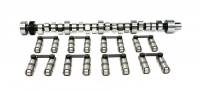
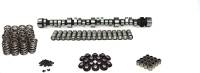
Browse Comp Cams Book Grinds- Hydraulic Roller Cams Products


Popular Brands:
More About Comp Cams Book Grinds- Hydraulic Roller Cams
The Bridge to Roller Power: Comp Cams "Book Grinds" for Pontiac V8s at Butler Performance
While Butler Performance is renowned for its custom-spec, high-horsepower hydraulic roller camshafts, they also recognize the value and utility of the tried-and-true Comp Cams "Book Grinds." These off-the-shelf hydraulic roller cams—specifically the popular Xtreme Energy (XR) series—provide Pontiac enthusiasts with a modern, high-performance valvetrain solution that is readily available and offers a significant upgrade over traditional flat tappet technology.
Butler Performance includes these proven profiles in their offerings, often as complete kits, providing a solid foundation for Pontiac engine builds ranging from mild street cruisers to potent mild-race applications.1
Key Benefits of the Hydraulic Roller Upgrade
Choosing a hydraulic roller cam, even a standard Comp Cams "book grind," delivers several major advantages over the older flat tappet designs, which Butler Performance consistently emphasizes:
-
Modern Aggressive Profiles: Hydraulic roller lifters use a wheel that follows the cam lobe, allowing the lobe profile to have a much quicker opening and closing rate than a flat tappet.2 This translates to increased valve lift and duration at 3$0.050$ inch (the effective power-making profile), yielding more area under the lift curve and, critically, more power without sacrificing low-end manners as much as a flat tappet with similar duration.4
-
Reduced Friction & Longevity: The rolling action of the lifter significantly reduces friction and wear within the valvetrain compared to the sliding motion of a flat tappet.
-
Safety from Failure: Roller cams eliminate the catastrophic risk of "wiping a lobe" (a common flat tappet failure, especially with modern low-ZDDP oils), which makes the break-in process much simpler and operation safer long-term.
-
Greater Vacuum: The quick lobe profiles can create more usable vacuum than a similarly powerful flat tappet, allowing builders to run a more aggressive cam while maintaining power brake function and a better idle.5
The Comp Cams Xtreme Energy (XR) Series: Proven Performance
The most popular hydraulic roller "book grinds" offered by Comp Cams for Pontiac V8 engines (265-455 ci) fall into the Xtreme Energy (XR) Hydraulic Roller category. These cams are characterized by their aggressive ramp rates and wide RPM ranges, making them excellent choices for hot street cars.
Butler's Full Kit Approach
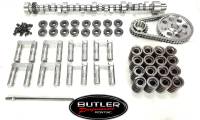
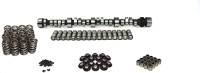
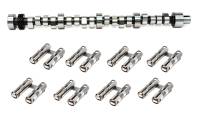
While the cam specifications originate from the Comp Cams catalog, Butler Performance often packages these "book grinds" into complete Master Kits (e.g., K-51-423-11 for the XR276HR). This ensures the builder receives a matched and reliable package, including:
-
Hydraulic Roller Lifters: High-quality lifters specifically rated for the aggressive roller profiles.
-
Valve Springs & Retainers: Correctly sized and rated springs to control the high lift and fast ramps of the roller cam.
-
Timing Set: A durable timing chain set (often double roller) for precision and reliability.
-
Distributor Gear: A polymer or bronze gear is necessary for use with the billet steel roller cam core.
By offering these Comp Cams hydraulic roller Book Grinds, Butler Performance provides Pontiac builders with easily accessible, well-engineered solutions that blend modern valvetrain performance with the classic appeal of the Pontiac V8.
FAQs
How much vacuum will a hydraulic roller cam produce?
Most street-friendly profiles maintain 12 to 16 inches of vacuum depending on displacement and lobe separation.
Do hydraulic roller cams require special oil?
They are less sensitive than flat-tappet cams, but high-zinc oil still improves valvetrain longevity.
Will a hydraulic roller cam improve throttle response?
Yes. Modern lobe designs typically sharpen throttle response across the RPM range.
How do I know if my springs match my cam?
Compare seat and open pressures to the cam card. Incorrect pressure can cause valve float or accelerated wear.
Can I run stock rockers with a hydraulic roller cam?
Only if lift and spring pressures fall within factory limits. Most performance builds benefit from upgraded rockers.