- Home »
- Catalog »
- Rotating Assemblies & Stroker Kits »
- 350 Blocks (358-413 cu. In.)
350 Blocks (358-413 cu. In.)

Pontiac V8 350 Blocks (358-413 cu. In.)
350 to 407 — 350 Blocks (358-413 cu. In.) for Pontiac V8s
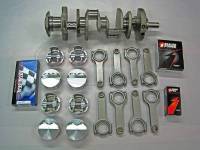
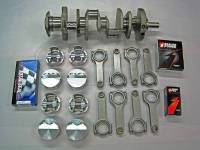
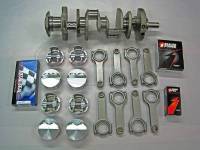
The Pontiac 350 shares the same block family as its bigger brothers, which is why a rotating assembly can take one well past its original displacement. Crank, rods, pistons, pins, rings and bearings are picked together so stroke, compression and bottom-end strength are decided once, up front, instead of discovered on the dyno.
Butler builds 350 block assemblies on the stock 3.750" stroke and on 4.000" and 4.250" stroker cranks — including a defined 407 ci combination — all on genuine Ross forged pistons using Butler's true-Pontiac forging, with Total Seal rings, performance bearings and internal balancing done here.
Browse 350 Blocks (358-413 cu. In.) Products


Popular Brands:
More About 350 Blocks (358-413 cu. In.)
1. The four ways to build a 350 bottom end
Butler groups the 350 block assemblies by stroke, and the rod length steps up with it so each one stays a true long-rod combination.
| 3.750" stock stroke | Butler/Ross custom balanced rotating assembly on a cast or forged 3.750" crank, bushed full-float H-beam 6.625" rods and 980 wrist pins. New parts, original stroke, your choice of piston shape. |
| 4.000" stroke, 383-388 ci | Balanced long-rod stroker assembly on a new cast or forged 4.000" crank with 6.700" H-beam rods and 990 pins. |
| 4.250" stroke, 407-413 ci | Balanced long-rod stroker assembly on a new cast or forged 4.250" crank with 6.800" H-beam rods, bore and ring type your call. |
| The 407 | A defined combination rather than an open spec — 4.250" stroke on a .030"-over 3.905" bore, with forged Butler/Ross pistons, 6.800" full-float bushed 4340 rods, Total Seal Classic Race rings and bearings selected for proper clearance. If your 350 cleans up at .030" over, this is the shortest route to 407 cubic inches. |
2. Cast crank or forged crank
This is the question most 350 buyers actually have to answer, and both answers are legitimate.
| New cast steel crank | An honest upgrade over a 30-plus-year-old factory crank, made with modern material and casting processes. Butler recommends it for street engines without power adders. |
| 4340 forged crank | More strength and durability, and cheap insurance if there is any chance of more power later. A forged crank keeps the door open without a second teardown. |
3. Machine-shop notes that change the order
| 557 castings | Butler does not recommend the stock-stroke long-rod assembly for blocks whose casting numbers end in 557 — thinner main webbing. We suggest holding those to 4.000" stroke and under 500 hp. |
| Hone to the pistons | Bore options start at .030" over so the block cleans up and the rings seat in spec. Have the pistons in hand when the cylinders are honed and set piston-to-wall clearance off the actual parts, not a chart. |
| Balance is not optional | These assemblies are internally balanced through the Butler Process, which means the engine needs a neutral-balanced flexplate or flywheel and a neutral balancer. |
A 350 that ends up a 407 still bolts into the same car, so the decision is really about heads, fuel and how much of the machine work is already done. Tell us where you are in the build and we will match the assembly to it.
Not sure what your Pontiac needs?
Email our tech team at tech@butlerperformance.com. Tell us your engine, heads, car, and power goal, and we will put the parts together as one combination that works.