Rotating Assemblies & Stroker Kits
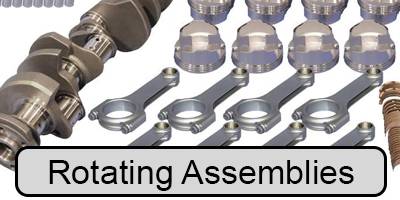
Pontiac V8 Rotating Assemblies & Stroker Kits
Start With the Block — Rotating Assemblies & Stroker Kits for Pontiac V8s
Rotating Assemblies and Stroker Kits are the bottom end of a Pontiac V8: crank, rods, pistons, pins, rings and bearings, matched as a set and balanced as a set. Get this right and everything above it works. Get it wrong and no cylinder head or camshaft will save the engine. Butler groups them by block family, because the block you already own is what decides how much stroke and how much displacement you can run.
We stock Butler/Ross custom balanced assemblies built on our exclusive true-Pontiac forging, Eagle street/strip and competition stroker kits, Build Your Own kits, and Butler Re-Ring and Rebuild kits for a stock rebuild.
Select a Sub-Category




Popular Brands:

More About Rotating Assemblies & Stroker Kits
1. What a Rotating Assembly Is, and What It Is Not
A rotating assembly is the crankshaft, connecting rods, pistons, wrist pins, rings and bearings — matched, pin fitted and balanced together. It does not include the block, the camshaft or the cylinder heads. It is the first piece you buy and the piece everything else gets designed around.
| Balanced assemblies | Shipped internally balanced by our shop, with bearings and Total Seal rings included, ready for your machinist to drop in. |
| Build Your Own kits | The same matched parts for you or your machinist to assemble, with balancing available separately. Pick your crank, pistons and compression. |
| Engine Builder Package | A 4.250 in. stroke assembly with a 4.150 in. to 4.211 in. bore, paired with Edelbrock RPM heads and a Comp hydraulic roller top end at 10.2-10.4:1 on 91-93 octane pump gas. Block not included; it is built for your block and your machine shop. |
| Butler terminology | An SBK is a Short Block Kit, the block plus the rotating assembly with no cam and no heads. An LBK is a Long Block Kit, an SBK with heads. A KIT is the full engine kit including cam, lifters, timing set, gaskets, oil and intake. A rotating assembly is the step before all three. |
2. Rebuilder Kits: Putting a Stock Pontiac Back Together
Not every Pontiac needs 500 horsepower. If you are freshening a numbers-matching engine, Butler Rebuilder Kits take the guesswork out with parts we have already checked against each other. They are listed for the 389, 400, 428 and 455.
| Re-Ring Kit | Rings, rod and main bearings and a complete gasket kit with rear main seal and oil pan gasket options. Federal Mogul bearings in standard, .010 in. or .020 in. undersize. For an engine whose bores still measure good. |
| Rebuild Kit, cast pistons | Adds hypereutectic cast pistons, pins and rings on top of the re-ring contents, in .030 in., .040 in. or .060 in. over. |
| Rebuild Kit, forged pistons | The same kit with forged pistons, in flat, dish or dome top, with the option to add a new cast or forged crank. |
| Read the compression estimates | Butler publishes an estimated compression ratio for each piston against specific chamber volumes. On the 389 cast kit the flat top estimates 11.1-11.3:1 against a 68cc chamber, flagged as high-octane fuel only. Check your chamber cc first. |
3. Butler/Ross Balanced Rotating Assemblies
Our own assemblies are built around genuine Ross forged pistons on a Butler-exclusive true-Pontiac strut-style forging, not the cheaper substitute pistons some sellers drop in at a similar price. They are nitrous safe, pin fitted and internally balanced here.
| Long rods | Bushed, full-float H-beam rods sized to the stroke — 6.625 in. at 3.750 in. stroke, 6.700 in. at 4.000 in., and 6.800 in. at 4.250 in. and up. |
| Included | Total Seal Classic Race rings, Federal Mogul or Clevite performance bearings, aftermarket wrist pins, pin fitting and the Butler internal balance. |
| Custom compression | Tell us your heads and your target and our techs work with Ross to design the piston to hit it. Custom dish pistons run a 10 to 12 week lead time, so order early. |
4. Eagle Street/Strip and Competition Kits
Eagle kits are the value lane and are stocked in the popular 400, 428 and 455 combinations. Street/Strip kits generally use forged 4340 I-beam rods and a cast crank; Competition kits step up to forged cranks and H-beam rods with ARP rod bolts.
| Piston choices | Mahle flat top or -22cc dish, depending on the compression you are chasing with your chamber. |
| File-fit rings | All Eagle kits come with file-fit rings, so budget the time to gap them properly. |
| Balancing is required | Eagle assemblies must be balanced before installation. Butler balancing is an option on every kit, and we recommend it — we do not take anyone else's word on parts we stand behind. |
5. Picking a Stroke for Your Block
These are the combinations Butler actually builds, by block family. Bore and stroke together set displacement, so do not assume a number you heard at a car show is available for your block.
| 326 block | Stock 3.750 in. stroke custom assemblies, a 4.000 in. stroke at 353-359 ci, and a 4.250 in. stroke at 376-382 ci. |
| 350 block | 3.750 in. stroke custom assemblies, 4.000 in. at 383-388 ci, and 4.250 in. at 407-413 ci — including a straightforward 407 on a .030 in. over 3.905 in. bore. |
| 389 block | 3.750 in. stroke, 4.000 in. at 421-427 ci, 4.250 in. at 447-454 ci and 4.500 in. at 473-480 ci. |
| 400 block | 3.750 in. at 406-413 ci, 4.000 in. at 433-440 ci, 4.210 in. at 455-462 ci, 4.250 in. at 460-468 ci, 4.375 in. at 471-480 ci and 4.500 in. at 487-495 ci. In Eagle terms, a 4.250 in. stroke on a .035 in. over 4.155 in. bore is the familiar 461, and 4.185 in. makes 468; a 4.500 in. stroke gives 488 at 4.155 in. and 495 at 4.185 in. |
| 421 block | 4.210 in. at 450-457 ci, 4.250 in. at 453-461 ci and 4.500 in. at 481-489 ci. |
| 428 block | 4.000 in. at 433-440 ci, 4.210 in. at 456-463 ci, 4.250 in. at 460-467 ci and 4.500 in. at 487-495 ci. |
| 455 block | 4.210 in. at 462-468 ci, 4.250 in. at 467-475 ci and 4.500 in. at 494-503 ci. |
| Aftermarket blocks | 4.000 in. at 455-481 ci, 4.250 in. at 482-511 ci and 4.500 in. at 511-541 ci. |
| LS blocks | Butler also lists rotating assemblies for LS1, LS2 and LS3. |
6. Choosing Your Options
| Crank, cast or forged | A new cast steel crank is an excellent, affordable upgrade over a factory crank that is more than thirty years old, and is recommended for street engines without power adders. A 4340 forged crank is cheap insurance that leaves the door open to add power later. |
| Bore | We start bore options at .030 in. over so the block cleans up and the pistons and rings seat within spec. Larger bores are available. Have the pistons in hand when the cylinders are honed so piston-to-wall clearance is set off the actual parts, not off a chart. |
| Rings | Total Seal is standard. Classic Race is plasma-moly; AP Advanced Stainless buys longer life and tighter tolerance; gapless top seals cylinder pressure between the top and second rings. |
| Wrist pins | Standard Ross 5115 chromoly pins are rated to 800 hp naturally aspirated. Step up to .220 in. wall bearing-steel pins for higher horsepower and power-adder builds. |
| The block gotcha worth knowing | Butler does not recommend a long stroke in blocks with casting numbers ending in 557. We suggest limiting those to a 4.000 in. stroke and under 500 hp because of the thinner main webbing. |
7. The Butler Process and the Balancing Question
Every rotating assembly we sell, regardless of brand, has to be balanced. Our process puts each part through a multi-step inspection, weighs and pin fits the rods and pistons as needed, and computer balances the crankshaft to the rest of the assembly. All weights and information are documented on a balance card that ships with the assembly.
| Internally balanced means neutral balance parts | Any internally balanced assembly requires a neutral balanced flexplate or flywheel and a neutral balanced harmonic balancer. Order them with the assembly, not after the engine is in the car. |
| Ask before you commit | Bore, chamber volume, fuel and future power adders all change which assembly is right. Call the shop with your block casting, your heads and your target. |
The short version: the block decides the stroke, the heads and fuel decide the piston, and the power target decides the crank, rods and pins. This page is grouped that way on purpose.
326 Blocks (336-382 cu.in.) 350 Blocks (358-413 cu. In.) 389 Blocks (395-480 cu. In.) 400 Blocks (406-495 cu. In.) 421 Blocks (427-489 cu. In.) 428 Blocks (433-495 cu.in.) 455 Blocks (462-503 cu. In.)
Not sure what your Pontiac needs?
Call our tech team at 866-762-7527. Tell us your engine, heads, car, and power goal, and we will put the parts together as one combination that works.