Headers and Exhaust Systems
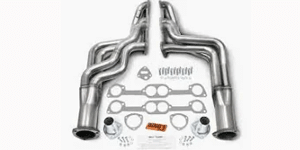
The exhaust system is the final, crucial component in a high-performance Pontiac V8. It is responsible for efficiently scavenging spent combustion gases, maximizing engine torque and horsepower. At Butler Performance, the selection of Headers and Exhaust Systems focuses on maximizing flow and minimizing back pressure, while also offering aesthetic and period-correct solutions.
Butler Performance offers both modern, tubular headers for maximum power and high-flow cast iron manifolds for a factory-correct look with upgraded performance.
Select a Sub-Category


Popular Brands:





More About Headers and Exhaust Systems
Letting it Breathe: Headers and Exhaust Systems for Pontiac Power at Butler Performance
1. High-Performance Headers
Tubular headers are the most effective way to increase power output, especially in the mid to upper RPM range. They replace the restrictive factory exhaust manifolds with smooth, mandrel-bent primary tubes of equal length that are routed to a high-flow collector.
-
Primary Tube Size and Fitment: Butler Performance supplies headers designed for various chassis (GTO, Firebird, Trans Am, Fullsize) and engine displacements.1 Selecting the correct primary tube size is crucial—larger tubes (e.g., 2" or greater) are for high-RPM, large-displacement engines, while smaller diameters (e.g., $1\frac{3}{4}\text{"}$ or $1\frac{7}{8}\text{"}$) are better for torque and street performance.
-
Coating and Materials: Headers are typically available in:
-
Raw Mild Steel: The most affordable option, best for racers who custom-coat their systems.
-
Ceramic Coated: A popular upgrade that provides a high-quality finish, reduces under-hood temperatures (which helps the engine and surrounding parts), and offers excellent corrosion protection.
-
-
Brands: Butler Performance carries headers from leading manufacturers known for Pontiac fitment, ensuring minimal hassle during installation around steering boxes and chassis components.2
2. Ram Air Exhaust Manifolds: Factory Performance
For many enthusiasts, maintaining a factory appearance is critical, even in a high-performance build. Butler Performance addresses this with modern reproductions of iconic Pontiac parts:
-
Ram Air Exhaust Manifolds: These manifolds are direct-fit replacements for the original restrictive units. They utilize a higher-flow design, like the factory Ram Air IV or similar high-performance manifolds, which offers a significant performance boost over the standard factory cast iron manifolds while retaining a completely stock look.
-
Benefits: They provide excellent ground clearance, are durable, and solve clearance issues that sometimes arise with tubular headers, making them ideal for high-end restorations.
3. Complete Exhaust Systems
Beyond the manifolds and headers, the system requires high-flow piping and mufflers.
-
Exhaust Systems: Butler offers full exhaust systems that include the X-pipe or H-pipe (to equalize pressure and improve scavenging), mandrel-bent piping, and performance mufflers. These systems are typically designed to maximize flow while providing the deep, classic muscle car tone.
-
Mufflers: High-performance mufflers from brands like MagnaFlow and Flowmaster (or equivalent high-flow units) are commonly used to provide maximum efficiency while controlling noise to acceptable levels.
4. Exhaust Accessories
Rounding out the category are the small, yet crucial, parts required for a complete and leak-free installation:
-
Header Bolts and Studs: Utilizing high-quality ARP fasteners to securely attach headers and manifolds, preventing leaks caused by loosening due to heat cycles.
-
Exhaust Header Gaskets: Specialized, high-temperature gaskets (often a multi-layer composite or crush-style design) are essential for sealing the header flange to the cylinder head, preventing frustrating exhaust leaks.
By focusing on both power-maximizing headers and historically correct, high-flow cast manifolds, Butler Performance provides a complete exhaust solution that caters to the diverse needs of the Pontiac muscle car community.
How Exhaust Systems Influence Pontiac Engine Performance
Exhaust flow is about more than reducing restriction. The way exhaust pulses travel through the system can influence torque production and overall engine efficiency. Properly matched performance headers and exhaust systems help create scavenging, a process that uses the energy of exhaust pulses to draw spent gases from the combustion chamber. This allows the incoming air-fuel charge to enter a cleaner cylinder, helping the engine operate more efficiently throughout the RPM range.
Pontiac enthusiasts often focus on cylinder heads and camshafts when chasing horsepower gains. However, as airflow increases with upgraded cylinder heads, intake manifolds, camshafts, solid roller lifters, and performance transmissions, the exhaust system becomes an increasingly important part of the overall combination.
Exhaust crossover design also affects how a Pontiac engine performs. An X-pipe can improve exhaust balance and support horsepower at higher RPM, while an H-pipe is often preferred for maintaining strong low- and mid-range torque in street-driven applications. Choosing the right setup depends on how the vehicle will be driven and where peak performance is needed.
How Header Size Affects Pontiac Torque and Horsepower
Selecting the correct header size is critical for maximizing Pontiac performance. Bigger is not always better.
Header primary tubes must be matched to engine displacement, cylinder head flow, compression ratio, and operating RPM. When primary tubes are too large, exhaust velocity can slow down, reducing the scavenging effect that helps build low-end torque.
For many Pontiac 400 and 455 street combinations, properly sized headers help maintain exhaust speed while improving throttle response and drivability. A larger-displacement stroker engine built for higher-RPM operation may benefit from larger primary tubes to support increased airflow demands. A street-driven GTO that rarely exceeds 5,500 RPM often requires a different exhaust strategy than a high-compression 535 stroker designed for drag racing. Matching the header to the combination helps ensure the engine produces usable power where it matters most.
At Butler Performance, we help Pontiac owners choose performance headers and exhaust systems that complement their specific goals, from mild restorations to full-on race cars.
From street-driven GTOs and weekend Trans Am cruisers to purpose-built race cars, the team at Butler Performance can match the right exhaust components to your Pontiac combination. Find out more about the accessories we offer.
FAQs
Does a larger exhaust system always make more horsepower?
No. While larger tubing can support greater airflow, excessive diameter may reduce exhaust gas velocity on smaller or lower-RPM combinations. Pontiac street engines often benefit from maintaining the right balance between flow capacity and velocity.
What is exhaust scavenging, and why does it matter?
Scavenging occurs when exhaust pulses help pull spent gases from the cylinder before the next combustion cycle begins. A properly designed header and exhaust system can improve cylinder filling, allowing the engine to draw in a cleaner air-fuel charge and produce power more efficiently throughout the RPM range.
Should I upgrade my exhaust system when installing new cylinder heads?
Usually, yes. High-flow cylinder heads can move more air than stock heads, and a restrictive exhaust system may limit their performance. Matching the exhaust system to your cylinder head upgrade helps the engine breathe more efficiently and make better use of the added airflow.