
NGK Spark Plug Selection Guide
Pontiac Engines — Aluminum & Cast Iron Heads
Pick your section by head material. Each track is self-contained — fitment, the full plug ladder across every application (street, strip, all-out race), and both fuel systems (carbureted and EFI).
A plug doesn’t make heat — it removes it. Heat range is how fast it sheds combustion heat into the cooling system. On NGK, the lower the number, the hotter the plug (a 6 is hotter than a 9). Too hot → pre-ignition and detonation. Too cold → fouling. Run the coldest plug that still stays clean — more power, compression, boost, or nitrous means a colder plug (higher NGK number).
| Application | Compression | Heat range |
|---|---|---|
| Pump-gas street | 9.0–10.75:1 | 6 or 7 (7 = safe starting point) |
| High-compression street / race | 10.75:1+ | 8 or 9 |
| Boost / nitrous | varies | 8, 9, or 10 by level |
Gap (Butler guideline): Points → .035″ · Electronic / MSD → .040″–.045″ · CDI/MSD box → follow the box’s instructions.
Butler’s first questions on any plug call: what heads? Street or race? Naturally aspirated or power adder? Those three set heat range and tip before anything else — and plug choice goes with tuning (timing curve, total timing, carb), stepping one range at a time off plug reads.
Where most Butler high-performance builds land, and where the full plug range lives. Fitment is shared across every application: 3/4″ reach · 14mm thread · gasket seat · 5/8″ hex. You only change heat range and tip style as the build gets more serious.
| Plug | NGK p/n | Butler item | HR | Tip | Resistor | Best for |
|---|---|---|---|---|---|---|
| NGK-6962 | BKR6E | NGK-6962-8 | 6 | Extended | Yes | Most street builds — Butler default |
| NGK-4091 | R5671A-7 | NGK-4091-8 | 7 | Recessed | No | Higher-HP street/strip — Butler default |
| NGK-4554 | R5671A-8 | NGK-4554-8 | 8 | Recessed | No | High-compression race (10.75:1+) |
| NGK-5238 | R5671A-9 | NGK-5238-8 | 9 | Recessed | No | Big-power race / mid-power-adder (~28–30° total to start) |
| NGK-5820 | R5671A-10 | NGK-5820-8 | 10 | Recessed | No | Nitrous / boost |
Street — NGK-6962 (BKR6E)
Heat Range 6, extended tip, resistor. The everyday pick for the majority of pump-gas aluminum-head Pontiacs. Drops straight onto EFI.
Higher Horsepower — NGK-4091 (R5671A-7)
Heat Range 7, recessed race tip, non-resistor. The step up once the build makes serious power or runs more compression.
1. Colder (HR6 → HR7) — more detonation margin for the higher-output build.
2. Extended tip → recessed tip — the recessed electrode pulls back into the shell, clearing domed pistons and removing a pre-ignition hot spot on high-compression combos. Extended (projected) tips sit deeper in the chamber and self-clean better at street speeds, which is why the street plugs use them.
3. Resistor → non-resistor — see EFI note below.
Carbureted, points: gap .035″. Resistor not critical — 6962 or the race plugs both work.
Carbureted, MSD/electronic: gap .040″–.045″. Resistor plug or resistor wires recommended.
EFI (FAST, Holley, etc.): resistor plugs strongly preferred — RFI from non-resistor plugs can disrupt crank/cam sensors and the ECU. The 6962 is already a resistor plug (plug-and-play on EFI). The 4091 and the rest of the R5671A race series are non-resistor — if you run them on EFI, use resistor plug wires to compensate. Gap per your ignition (commonly .040″–.045″, tighter on high-cylinder-pressure builds).
Gap notes: more ignition energy + lower cylinder pressure → open the gap (.040–.045). More cylinder pressure (high compression, boost, nitrous) → tighten to prevent spark blowout. The 4091 ships pre-gapped tight (~.020″) for race use — open it to your target for most naturally-aspirated street/strip combos.
Factory iron heads are the constraint — seat type and reach are fixed by the casting. Pontiac changed the spark plug seat around 1972, so read fitment first.
| Cast iron head | Reach | Seat | Hex |
|---|---|---|---|
| ’71 & earlier | 3/8″ | Gasket | 13/16″ |
| ’72 & up | .460″ | Taper / “peanut” | 5/8″ |
FITMENT WARNING
A gasket-seat plug will not seal in a taper-seat head, and vice-versa. A pre-’72 plug is also the short 3/8″ reach — you cannot drop a 3/4″-reach aluminum-head race plug (like the 4091) into a factory iron head.
| Head (seat · reach) | NGK p/n | Butler item | HR | Tip | Resistor | Best for |
|---|---|---|---|---|---|---|
| ’71 & earlier (gasket · 3/8″) | R5670-6 | NGK-2746-8 | 6 | Extended | No | Street builds — Butler default |
| ’71 & earlier (gasket · 3/8″) | R5670-7 | NGK-2891-8 | 7 | Extended | No | Higher-compression engines |
| ’72 & up (taper · .460″) | YR-5 | NGK-7052-8 | 5 | Recessed | Yes | Lower-compression / milder street |
| ’72 & up (taper · .460″) | R5674-6 | NGK-4449-8 | 6 | Extended | No | Street builds — Butler default |
| ’72 & up (taper · .460″) | R5674-7 | NGK-5034-8 | 7 | Extended | No | Higher-compression engines |
Same rule as everywhere else: colder plug (higher number) as compression climbs. The YR-5 is the one resistor plug in the group, which makes it the natural pick on an EFI ’72+ iron-head car. Butler’s own guideline for these heads: pump-gas street −5 to −7, high-compression race −8 to −9.
Street / mild performance: the R5670-6 (HR6) is the plug — factory iron heads, pump gas, typical compression. This is the right combination.
Strip / higher output: factory iron heads top out fairly low on power and compression before they become the limiting factor. The practical move for serious power is switching to aluminum heads (Part 1) — which is exactly why Butler’s full heat-range ladder lives in the aluminum category.
All-out race on iron heads (ported round-port, aftermarket iron): colder plugs in the NGK racing series exist, but matching them to your specific reach and seat is a call-Butler item — don’t assume a number off an aluminum-head chart will fit an iron casting.
Most iron-head Pontiacs are carbureted, but the same logic applies. Carbureted, points: gap .035″. Carbureted, MSD/electronic: gap .040″–.045″; resistor plug or wires recommended. EFI on iron heads (uncommon but valid): use resistor plugs or wires to keep RFI out of the ECU/sensors, and gap per your ignition. Heat range window for pump-gas iron-head street: HR 6–7, with the R5670-6 as Butler’s stocked answer.
Pull a plug after a few heat cycles or a pass:
Light/white, blistered insulator, melted electrode → too hot / too lean / too much timing → go a step colder, richen, or back off timing.
Black, sooty, wet/oily → too cold / too rich / fouling → go a step hotter or fix tuning.
Light tan/brown insulator, ground strap colored ~halfway up → correct.
When unsure, start one step colder than you think you need — a cold plug only risks fouling, a hot plug risks the engine — and read from there.
Heat-range and gap guidelines per Butler’s published spark plug information; part numbers and fitment reflect Butler’s current catalog. Verify against your specific head, compression, and ignition combination. When a setup is borderline, call Butler — every combination is different.
Spark Plug- Information
Spark plugs do not create heat, they can only remove heat. The spark plug works as a heat exchanger by pulling unwanted heat away from the combustion chamber, and transferring the heat to the engine’s cooling system. The heat range is defined as a plug’s ability to dissipate heat.
The spark plug has two primary functions:
- To ignite the air/fuel mixture
- To remove heat from the combustion chamber
Types of Abnormal Combustion:
Pre-ignition
- Defined as: ignition of the air/fuel mixture before the pre-set ignition timing mark.
- Caused by hot spots in the combustion chamber…can be caused (or amplified) by over advanced timing, too hot a spark plug, low octane fuel, lean air/fuel mixture, too high compression, or insufficient engine cooling.
- A change to a higher-octane fuel, a colder plug, richer fuel mixture, or lower compression may be in order.
- You may also need to retard ignition timing, and check vehicle’s cooling system.
- Pre-ignition usually leads to detonation; pre-ignition and detonation are two separate events.
Detonation
- The spark plug’s worst enemy! (besides fouling)
- Can break insulators or break off ground electrodes.
- Pre-ignition most often leads to detonation.
- Plug tip temperatures can spike to over 3000°F during the combustion process (in a racing engine).
- Most frequently caused by hot spots in the combustion chamber.
- Hot spots will allow the air/fuel mixture to pre-ignite. As the piston is being forced upward by mechanical action of the connecting rod, the pre-ignited explosion will try to force the piston downward. If the piston can’t go up (because of the force of the premature explosion) and it can’t go down (because of the upward motion of the connecting rod), the piston will rattle from side to side. The resulting shock wave causes an audible pinging sound. This is detonation.
- Most of the damage that an engine sustains when “detonating” is from excessive heat.
- The spark plug is damaged by both the elevated temperatures and the accompanying shock wave, or concussion.
Misfires
- A spark plug is said to have misfired when enough voltage has not been delivered to light off all fuel present in the combustion chamber at the proper moment of the power stroke (a few degrees before top dead center).
- A spark plug can deliver a weak spark (or no spark at all) for a variety of reasons…defective coil, too much compression with incorrect plug gap, dry fouled or wet fouled spark plugs, insufficient ignition timing, etc.
- Slight misfires can cause a loss of performance for obvious reasons (if fuel is not lit, no energy is being created).
- Severe misfires will cause poor fuel economy, poor drivability, and can lead to engine damage.
Fouling
- Will occur when spark plug tip temperature is insufficient to burn off carbon, fuel, oil or other deposits
- Will cause spark to leach to metal shell…no spark across plug gap will cause a misfire
- Wet-fouled spark plugs must be changed…spark plugs will not fire
- Dry-fouled spark plugs can sometimes be cleaned by bringing engine up to operating temperature
- Before changing fouled spark plugs, be sure to eliminate root cause of fouling
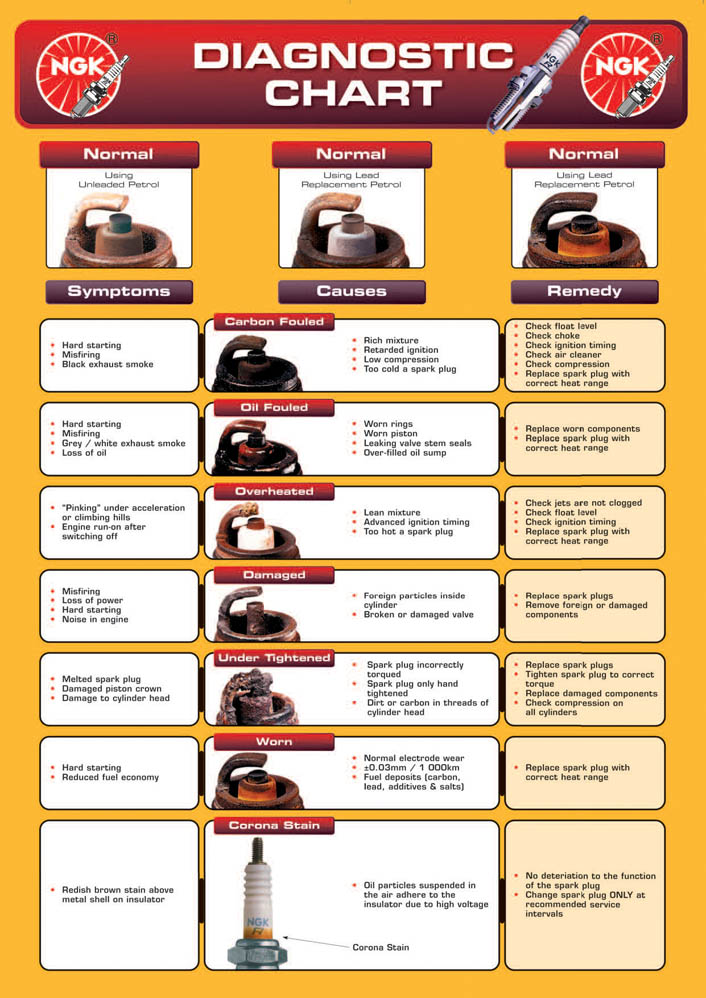
If you have questions about the heat range on an NGK spark plug.
The lower the #, the hotter the plug is.
(Example- 6 is a hotter plug than 9)
General Guidelines:
Pump gas low compression(9.0 or less) street engines would use a 6 or 5 heat range plug
Pump gas 9.0-10.75 compression street engines would use a 7 or 6 heat range plug.
High compression(10.75+ street/race engines may use an 8 or 9 heat range plug.
Boosted/nitrous engines may use a 8, 9 or 10 heat range plug depending on levels of boost/nitrous.
A 7 heat range is usually a safe starting point for pump gas street engines.Spark plug gap for Points is .035 and any electronic or MSD is .040"-.045". If running a CDI/MSD box; refer to the recommendations in the instructions.
Powered by Web Shop Manager.