
A Pontiac block leaves the foundry full of holes. Some are core holes left by the casting sand, some are drilled oil galleries, and some are drains. Every one of them has to be sealed before the engine runs, and several of them are impossible to reach once the engine is in the car. This page walks the block position by position.
A 1967-and-later factory block has 15 plug positions. A 1966-and-earlier block has 13 — Pontiac ran two coolant core plugs per side through 1966 and added a third in 1967.
Click any photo to open it full size.
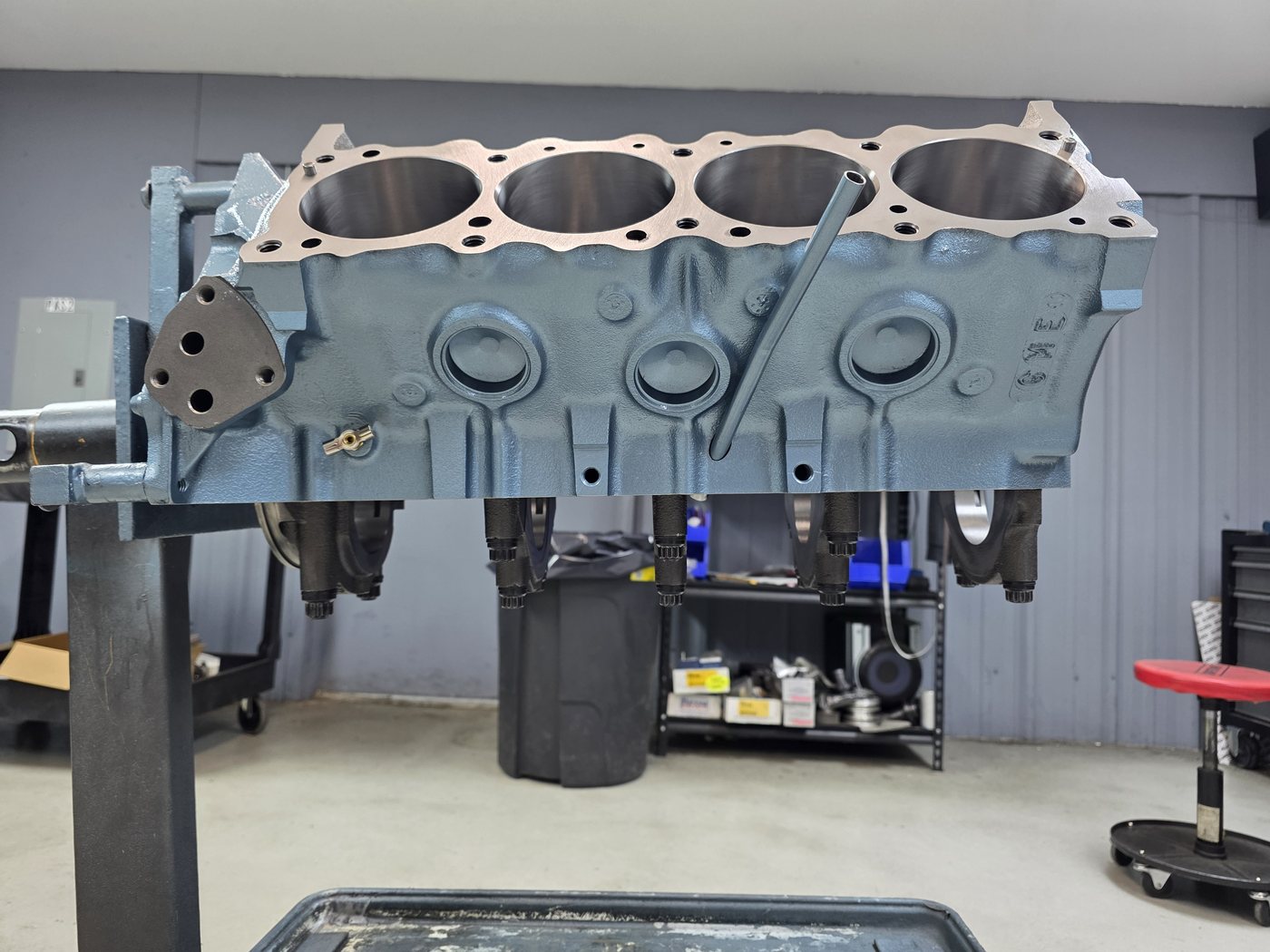
Finished Pontiac short block on the stand. Three coolant core plugs across the side, fuel pump boss at the left end, brass drain spigot and dipstick tube below.
| Position | Size / Qty / Part |
| Block sides, coolant core plugs | 1-61/64″ cup · 3 per side (1967+), 2 per side (1966 and earlier) · PIO-EPC42B |
| Rear of block, coolant core plugs | 1-61/64″ cup · 2 · PIO-EPC42B |
| Block coolant drains, lower sides | 1/8″ NPT · 2 (one per side) · MCM-50925K209 or FSC-135 |
| Rear camshaft tunnel | 2-1/16″ cup · 1 · PIO-EPC112 |
| Front of block, main oil galleries | 9/16″ press-in · 2 · PIO-EPC48 — or tap the same hole for 3/8″ NPT, PIO-PP554 |
| Behind the distributor, passenger side oil galley | 3/8″ NPT, drilled .040″ · 1 · PIO-PP475 |
| Rear of block, passenger side outer oil galley | 15/16″ press-in · 1 · PIO-EPC39 |
Cylinder head plugs are a separate set and are listed at the bottom of this page.
| Size | 1-61/64″ (1.953″) cup / expansion plug |
| Quantity | Three per side on 1967 and later blocks. Two per side on 1966 and earlier blocks. |
| Location | Outboard face of each bank, in a row below the deck, behind the exhaust manifolds |
| Part number | PIO-EPC42B (brass, each) |
These are the plugs everyone pictures when they hear “freeze plug.” They fill the core holes left where the sand cores that formed the water jacket were supported. The plug-count change in 1967 is one of the fastest ways to date an unknown block in a salvage yard: two holes per side is 1966 or earlier, three is 1967 or later.
Brass is the upgrade over steel. Steel plugs rust from the inside out and are the usual reason a rebuilt engine is back out of the car two years later; brass does not corrode the same way and costs a few dollars more for the whole engine.
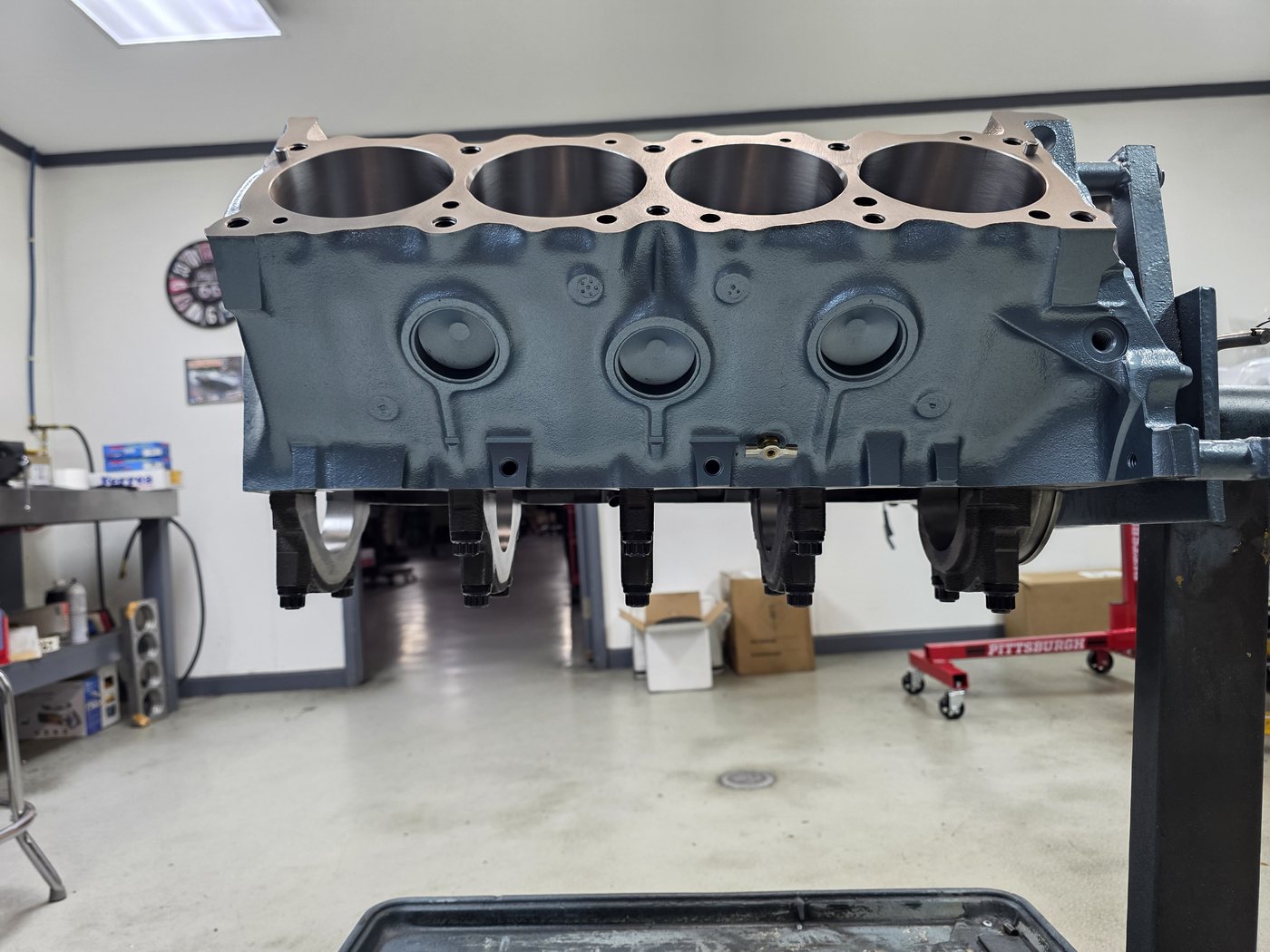
The three side core plugs on a 1967-and-later block, painted with the block. A 1966-and-earlier block has two.
| Size | 1-61/64″ cup / expansion plug, same as the block sides |
| Quantity | 2 |
| Location | Rear face of the block, behind the bellhousing flange — one per bank |
| Part number | PIO-EPC42B (brass, each) |
Do not skip these. The two rear core plugs are behind the flexplate and the bellhousing. Once the engine and transmission are together and in the car, reaching them means pulling the engine back out. They cost a few dollars and they get replaced on the stand, every time, no exceptions.
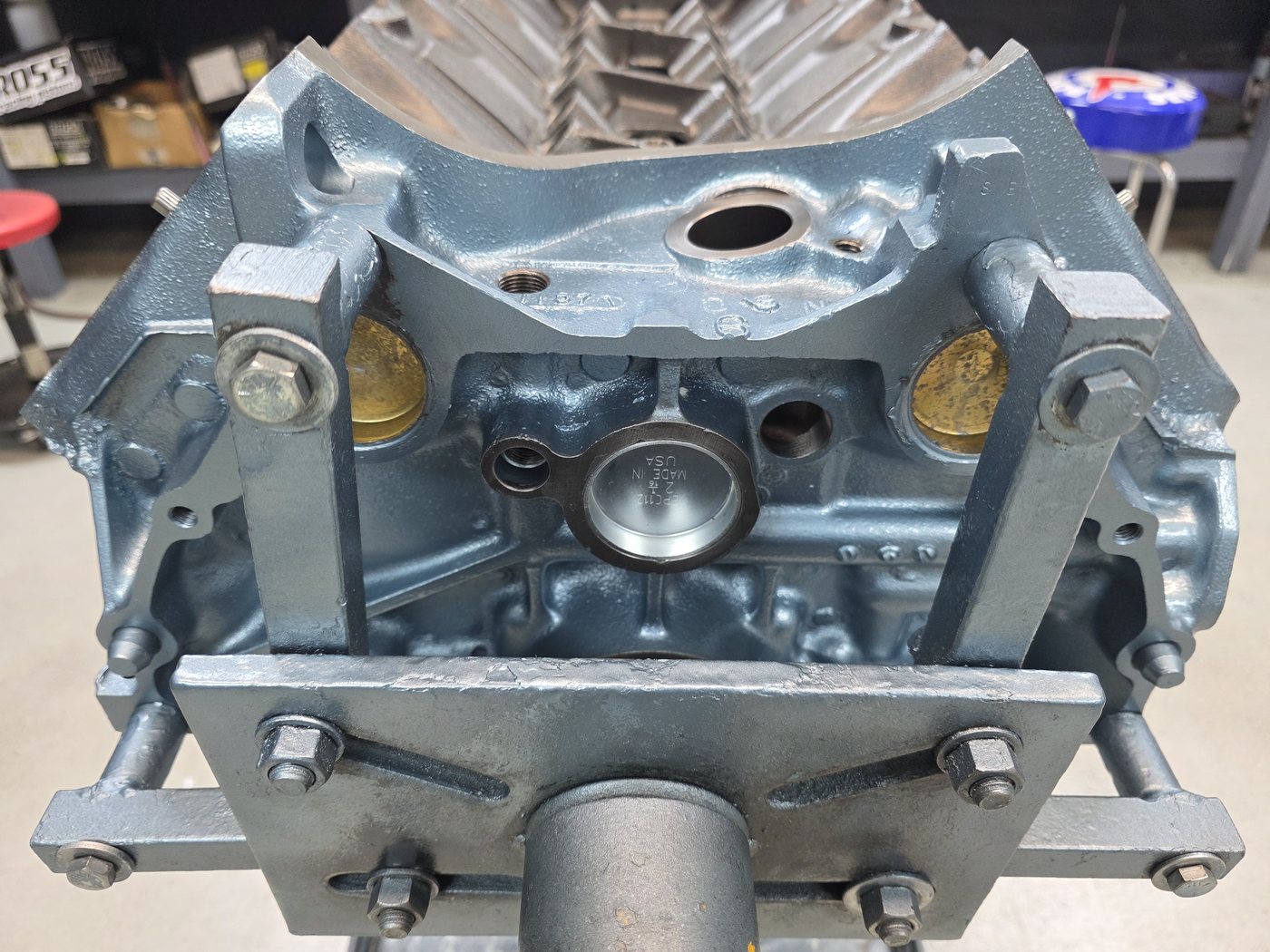
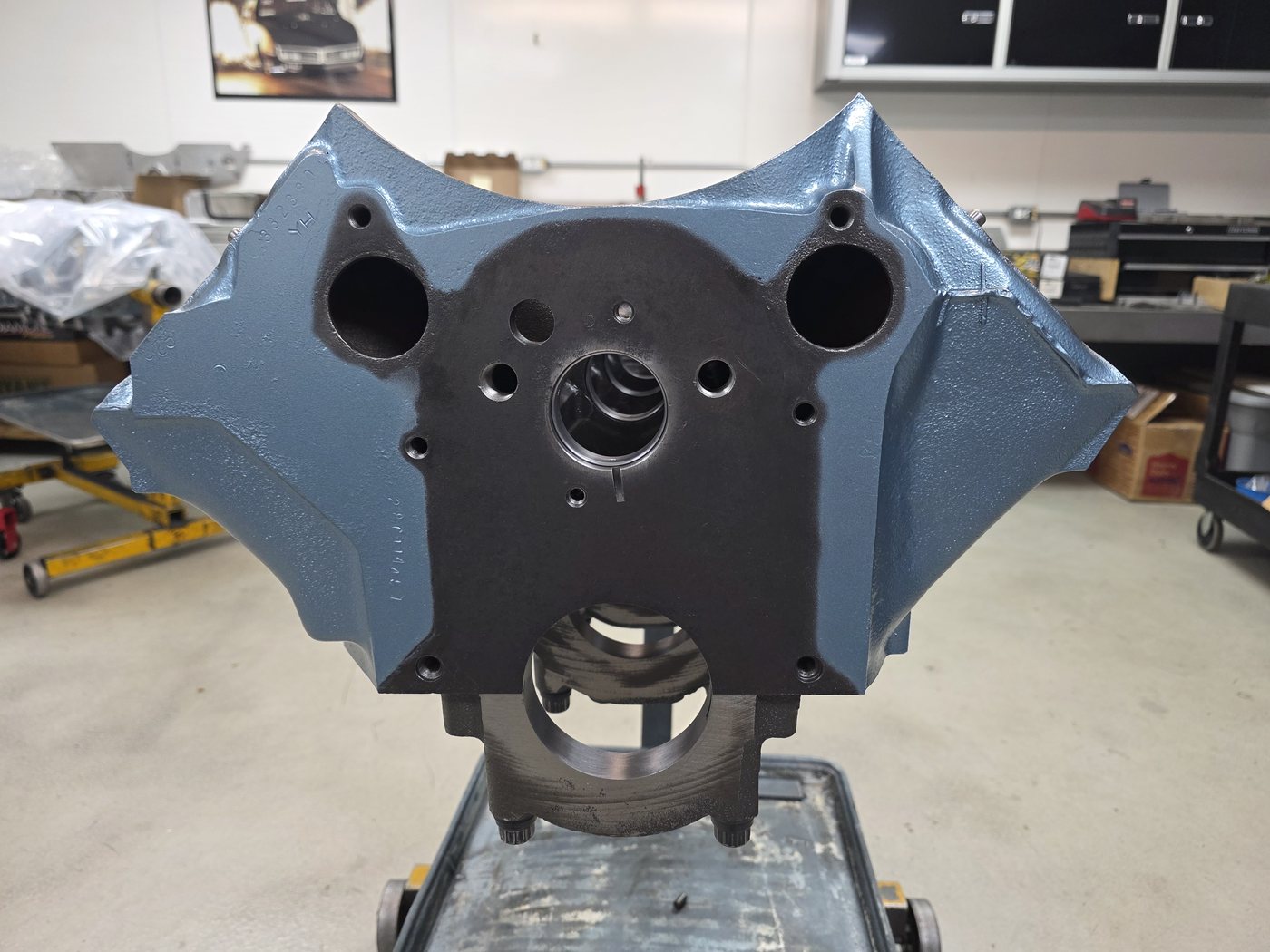
Rear face of the block: brass coolant core plug on each side, cam plug in the center, threaded oil galley holes flanking it.
| Size | 1/8″ NPT |
| Quantity | 2 — one per side |
| Location | Low on each side of the block, at the bottom of the water jacket |
| Part numbers | MCM-50925K209 — steel, 7/16 hex head FSC-135 — brass drain spigot, the standard size for Pontiac blocks |
These are the lowest point in the water jacket, so they are also where the rust and casting sand collects. On a block that has been sitting they are frequently rusted solid.
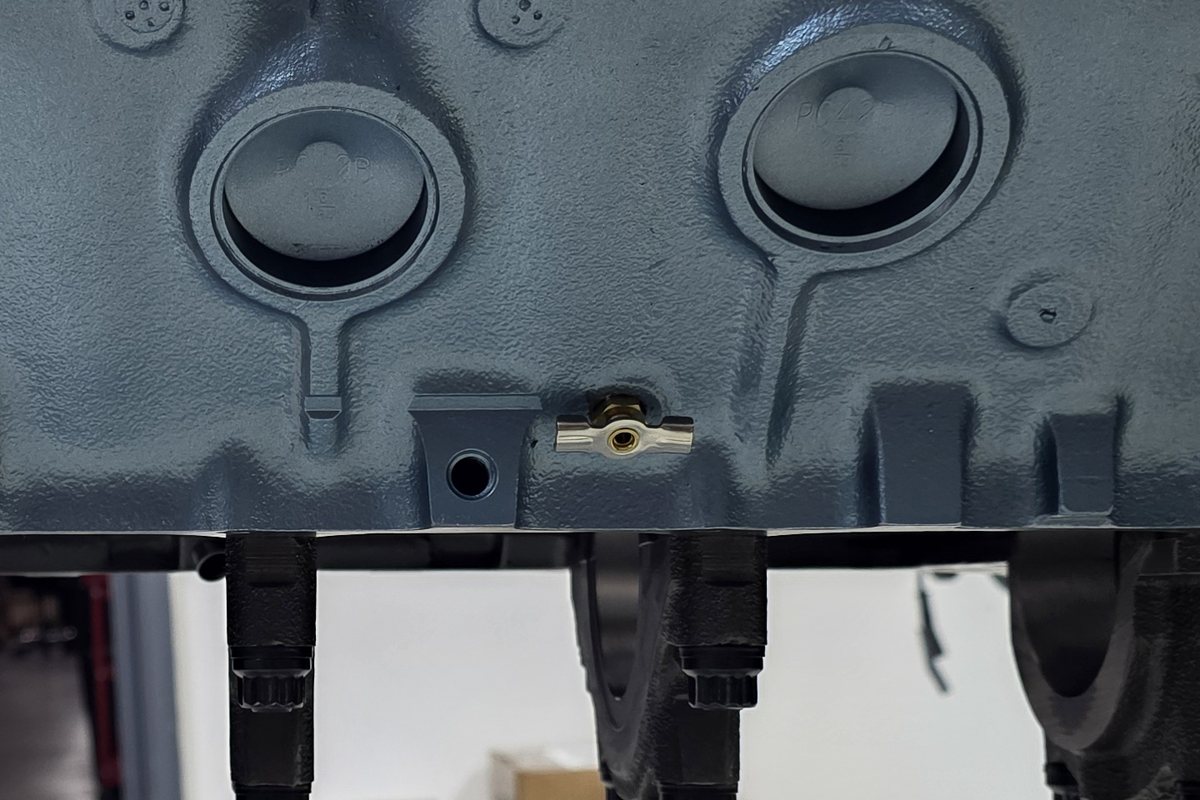
Brass drain spigot in the block drain port, low on the side below the core plugs. The open boss to its left is the second drain location on this casting.
You have a choice at these two ports: a plug or a spigot. The plug is what Pontiac used — MCM-50925K209 is the 1/8″ NPTF steel drain plug with a 7/16 hex drive, and it seals and disappears. The drain spigot, FSC-135, threads into the same 1/8″ port but adds a small T handle and an outlet, so draining the block is a matter of turning it open by hand and catching the coolant.
The spigot is the better answer for an engine that actually gets its coolant changed. Brass will not seize into the block the way a rusted steel plug does, and you are not trying to get a wrench onto a fitting low on the block with the headers in the way. Both parts are sold individually, so order two either way — there is one port on each side of the block. Use sealant on the pipe threads, and do not gorilla either one into cast iron.
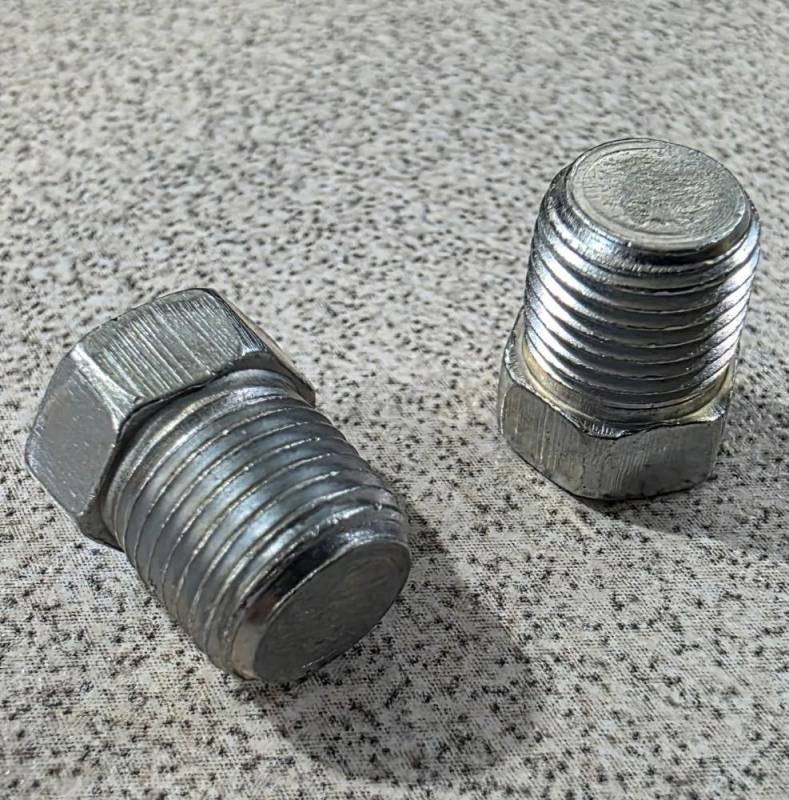
MCM-50925K209 — the 1/8″ NPTF steel drain plug, 7/16 hex drive. The plain seal-it-and-forget-it option.
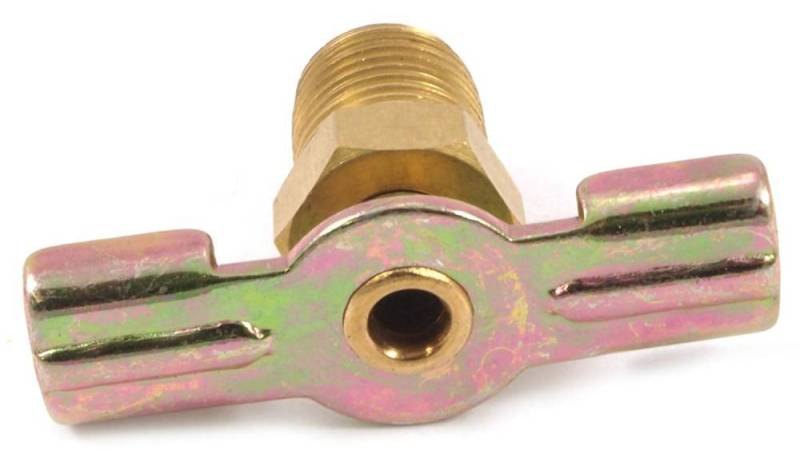
FSC-135 — the 1/8″ brass drain spigot, the standard size for Pontiac blocks. Open it by hand, drain the block, close it again.
| Size | 2-1/16″ cup plug, steel |
| Quantity | 1 |
| Location | Rear face of the block, directly behind the camshaft, sealing the back of the cam tunnel |
| Part number | PIO-EPC112 |
This one is not holding coolant — it is holding oil, and it is the plug most often blamed for a “rear main seal leak” that is not a rear main seal leak. The cam tunnel is pressurized with oil, so a cam plug that is cocked, loose, or installed without sealer will drip down the back of the block and onto the bellhousing exactly the way a bad rear seal does.
Like the rear core plugs, this is a stand-only job. Sealer on the outside diameter, drive it in square with a flat driver that contacts the outer rim, and seat it evenly. It is buried behind the flexplate once the engine is assembled.
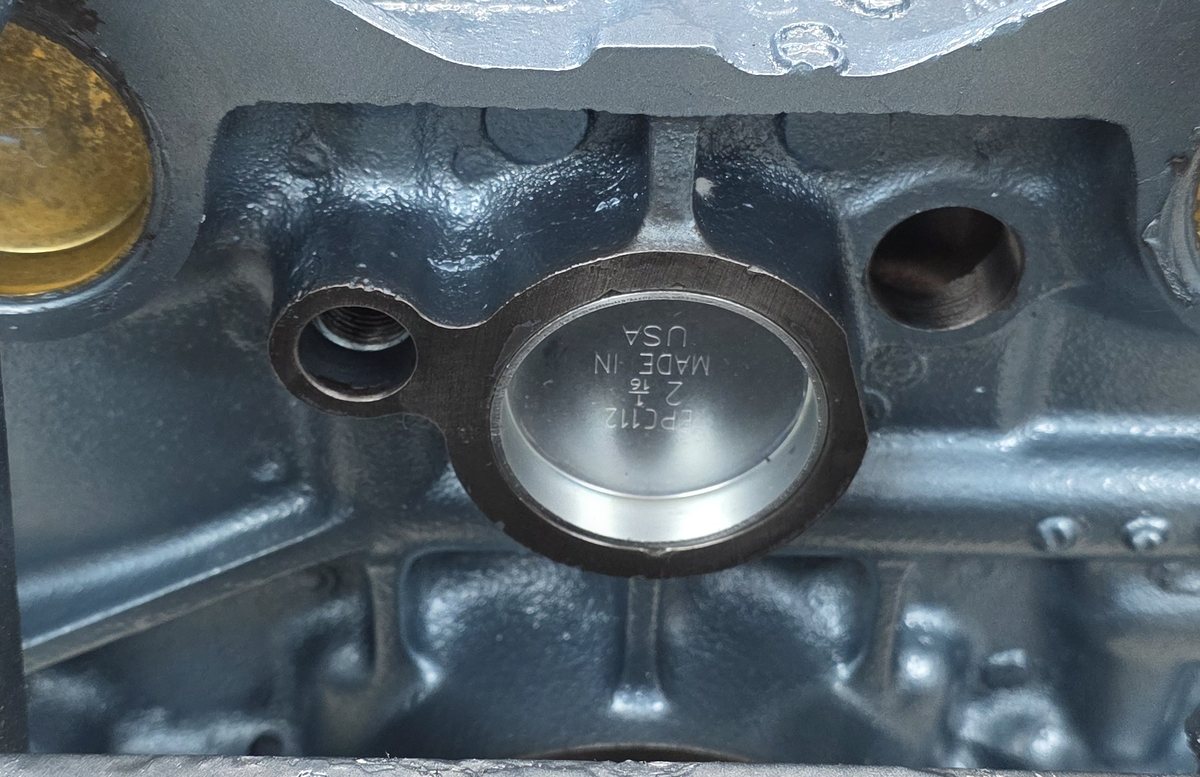
The 2-1/16″ cam plug seated in the back of the cam tunnel — part number stamped right on the face. Brass rear core plug at upper left.
| Size | 9/16″ press-in plug (factory), or 3/8″ NPT if the holes are tapped |
| Quantity | 2 — one per main galley |
| Location | Front face of the block, behind the timing cover, at the front end of each main oil galley |
| Part numbers | PIO-EPC48 — 9/16″ press-in PIO-PP554 — 3/8″ NPT, not drilled, for tapped blocks |
Most stock Pontiac blocks use press-fit, staked front oil galley plugs. Under very high oil pressure a loose plug can push out and dump oil internally, so a popular insurance step is tapping those same two holes for 3/8″ NPT pipe plugs. It is one location with two ways to seal it — the 3/8″ NPT plug is not an additional plug somewhere else, it is the replacement for the 9/16″ press-in. The Butler Ultimate Block Plug Kit includes two 3/8″ threaded plugs for exactly this, alongside the press-in plugs.
Use restraint on the pipe plugs. Thread one in too far and its taper will choke the galley and restrict flow where you do not want it restricted. Short-length plugs exist for this reason.
Front of the block with the timing cover off: cam thrust plate area, crank snout, and the oil galley holes above the cam bore.
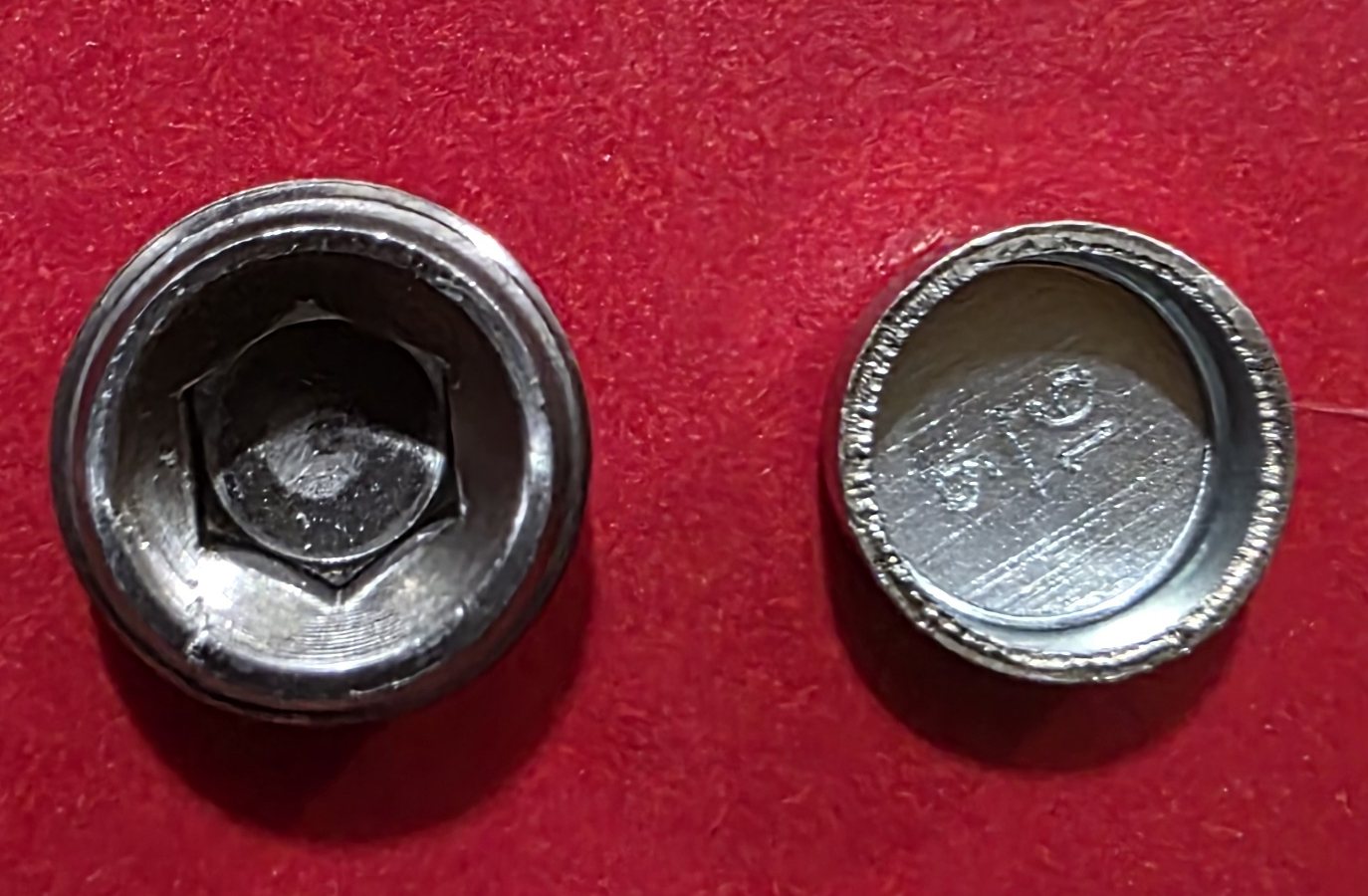
One hole, two ways to seal it. The 9/16″ press-in plug on the right is what Pontiac used at the front oil galley; the 3/8″ NPT pipe plug on the left threads into that same hole once it has been tapped.
| Size | 3/8″ NPT threaded pipe plug — not a press-in plug |
| Quantity | 1 |
| Location | Inside the block, passenger side rear oil galley, directly behind the distributor |
| Part numbers | PIO-PP475 — drilled, .040″ orifice, feeds oil to the distributor PIO-PP554 — same plug, not drilled |
| Tool | BPI-1030 — Butler pipe plug tool, made for this plug and the 3/8 hex plugs |
This is the one that catches people out. It is a hidden, recessed passenger-side cam oil galley plug that sits underneath the externally visible plug on the back of the block, so it is invisible with the distributor in place and easy to leave alone through a rebuild. It is threaded rather than pressed, so trying to drive it out like a cup plug accomplishes nothing but damage.
The drilled version matters. The .040″ orifice in PP475 supplies oil to the distributor gear, and the bleed also keeps sludge from building up in the cam gallery. Fit a solid plug where a drilled one belongs and that oil supply is gone; fit a drilled one where it does not belong and you have an unintended leak in the galley. Match what came out, and if the block is a mystery, confirm before you button it up. 455 Super Duty engines left the factory with the bleed hole already in place.
Expect it to be seized. Decades of heat cycling and this plug does not want to move. Apply heat before you lean on it — that is what keeps you from snapping the end off the install tool.
Passenger-side lifters clattering, driver side quiet?
That is the signature of this plug being missing. Machine shops routinely pull it to hot-tank a block and then do not put it back, which leaves an internal oil leak: the passenger-side lifters clatter, and the cam lobes go eventually. It will not show up on the oil pressure gauge, because the gauge reads pump output rather than the actual line-pressure drop. Reported by Marlan Davis in HOT ROD.
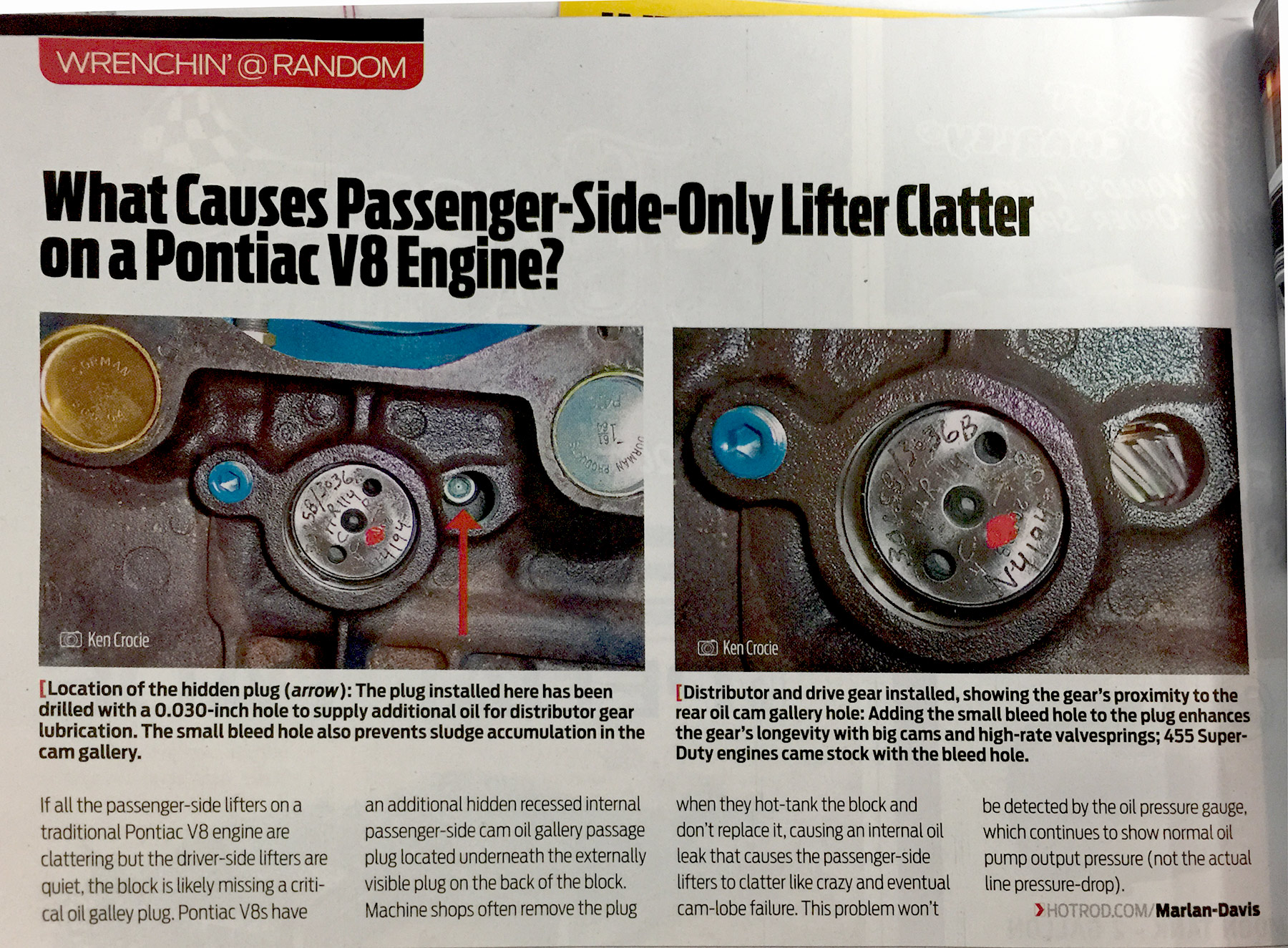
The hidden plug, arrowed. It is recessed below the externally visible plug on the back of the block — which is exactly why a block can come back from the machine shop without it. Photo: HOT ROD / Ken Crocie, used with permission.
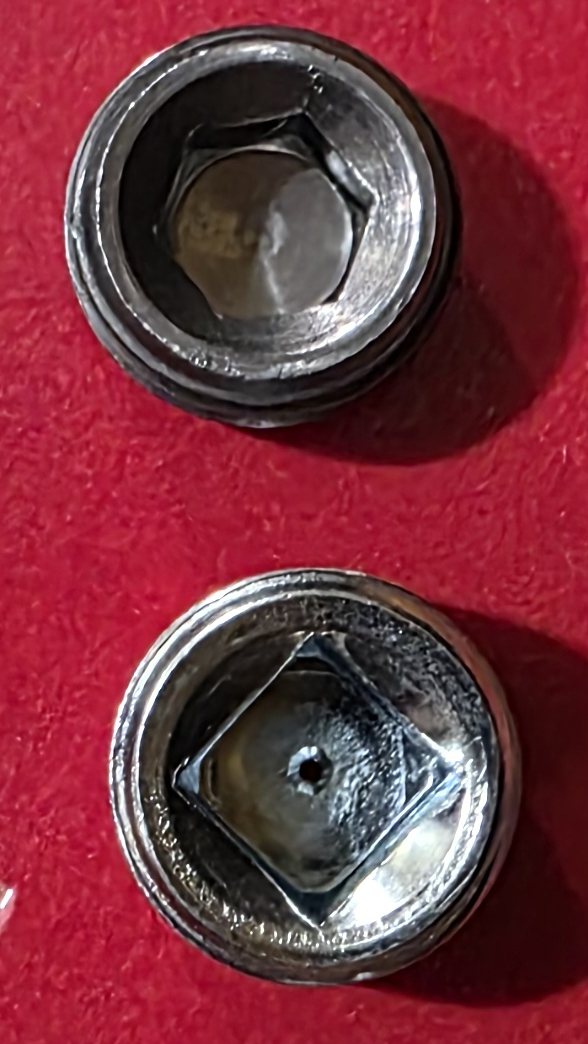
Drilled against solid. The lower plug has the metering orifice through the center of its face; the upper one is closed. Getting these two backwards is the mistake this page exists to prevent.
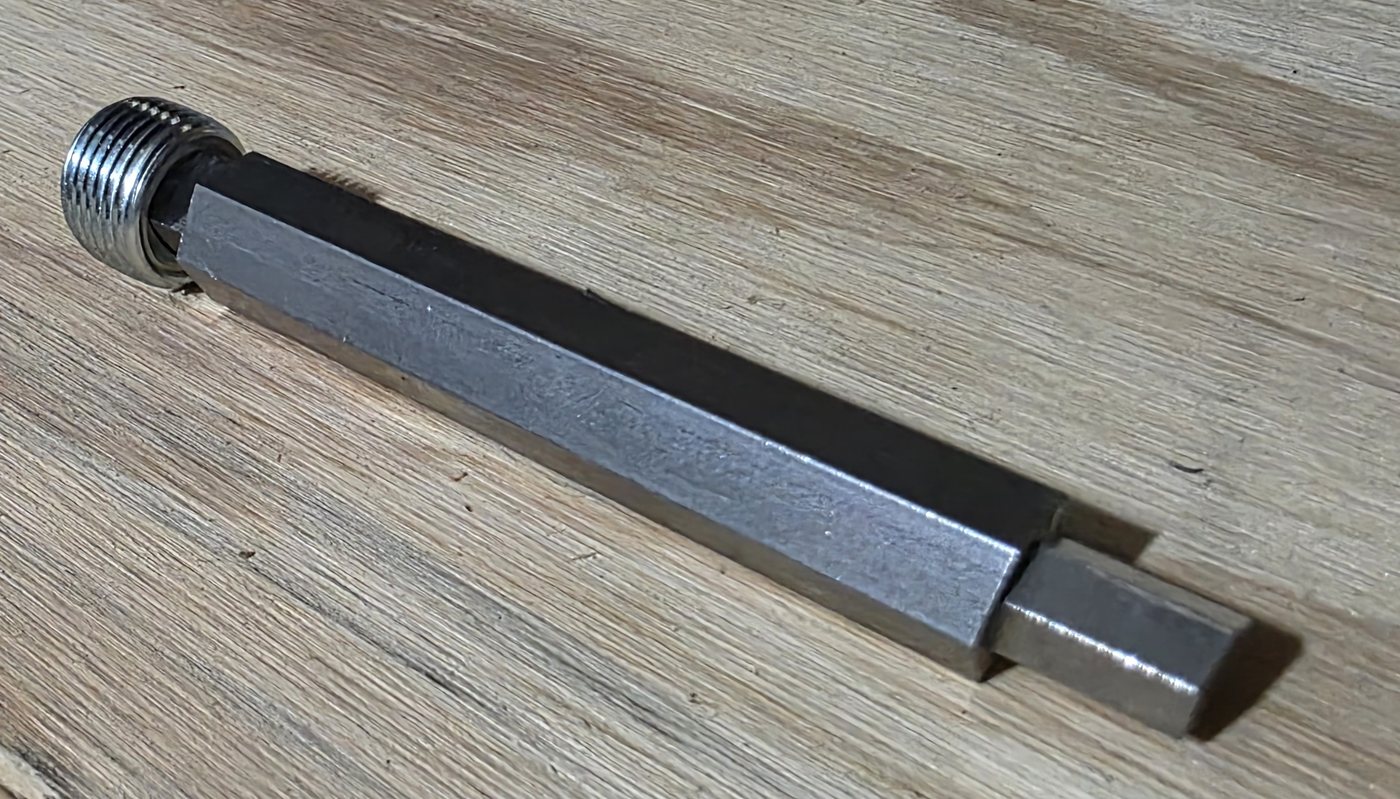
The Butler pipe plug tool with a 3/8″ plug threaded on the end — the only practical way to reach the galley plug down behind the distributor.
| Size | 15/16″ press-in plug, steel |
| Quantity | 1 |
| Location | Rear of the block, passenger side, outer oil galley |
| Part number | PIO-EPC39 |
This is the plug you can see from outside on the back of the block, and it is a press-in cup plug. It is not the same plug as the threaded one in the section above — that one is recessed down underneath this one. Both get called “the rear oil galley plug” in conversation and they are not interchangeable, so if someone asks for a rear galley plug, find out which one they are holding first.
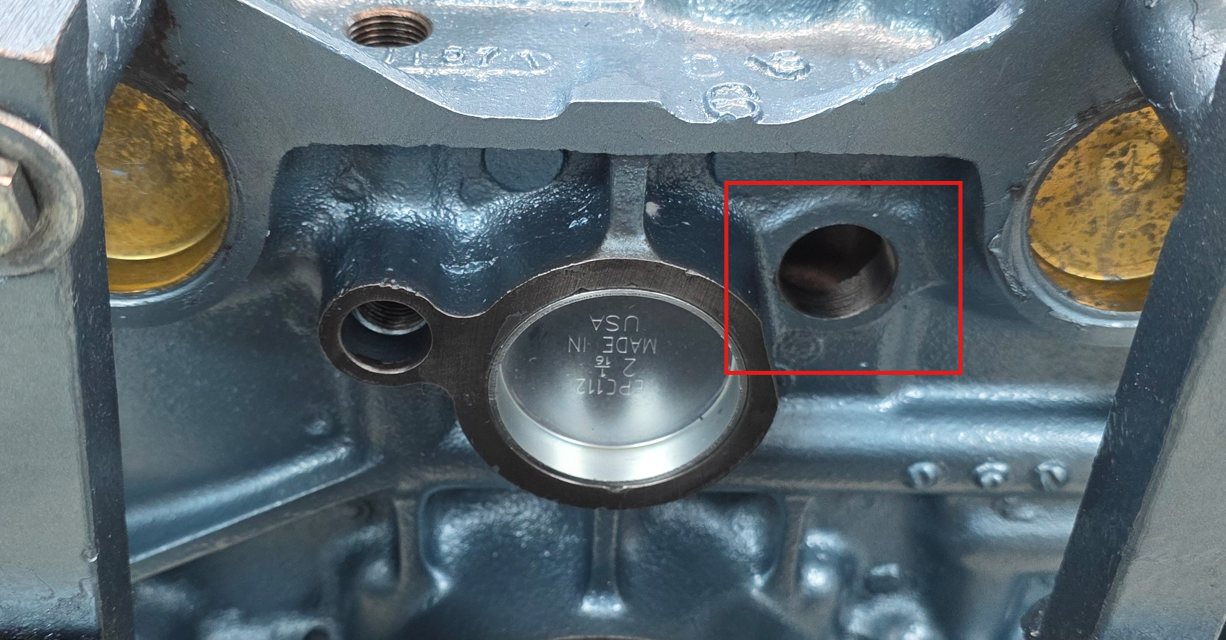
The 15/16″ outer oil galley location, boxed — rear face of the block, outboard of the cam plug. Shown open here; the plug presses into this bore.
This plug goes in last, not first. Seat the drilled plug from the section above before this one goes anywhere near the block. Press this one in first and you have sealed off the plug behind it — which means pulling it back out to get at the one that actually matters.
The two 3/8″ pipe plugs that come in a block plug kit are the front-of-block alternates — they go in the 9/16″ press-in holes once those are tapped, not in an extra location of their own. Beyond that, blocks pick up assorted pipe plugs over their lives at accessory, gauge and oil ports, and those vary by year, application and by whatever the last builder did.
| 3/8″ NPT, not drilled | PIO-PP554 — oil galley holes |
| 1/4″ NPT | PIO-PP567 — internal Allen head, steel |
| 1/2″ NPT | PIO-PP568 — internal Allen head, steel |
Measure the hole you are filling rather than ordering by memory. If you are not certain what a port is, call before you plug it — 866-762-7527.
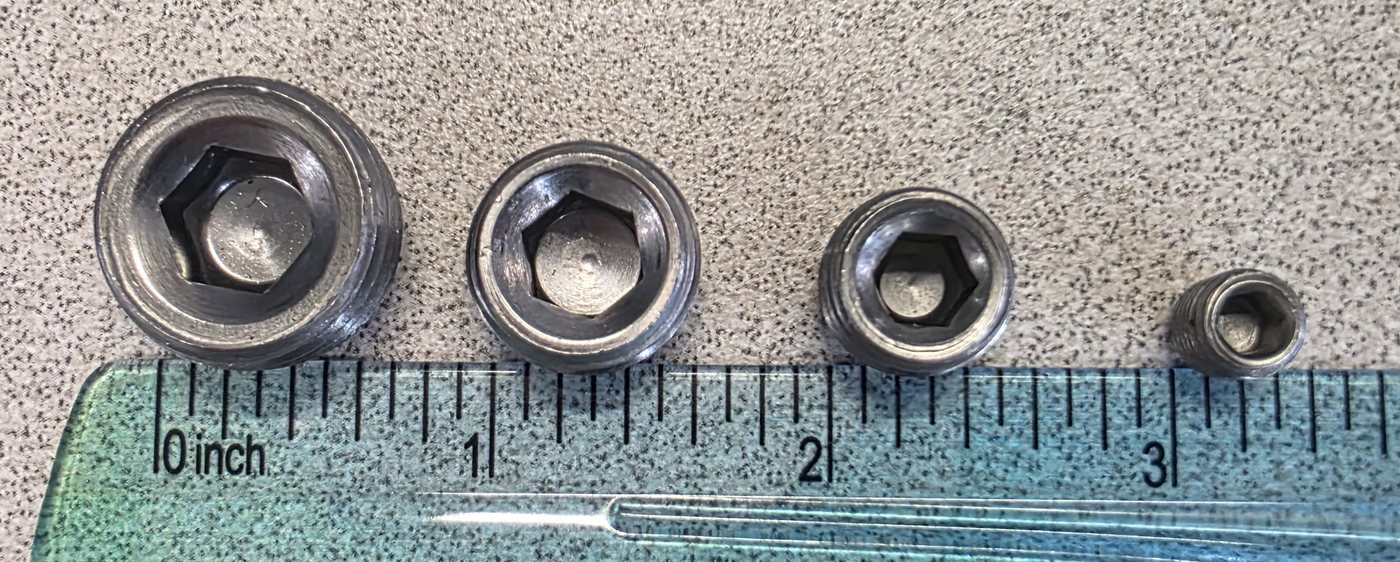
The pipe plug family with a rule for scale — 1/2″, 3/8″, 1/4″ and 1/8″ NPT, largest to smallest.
| Stock rebuild | Performance build |
| Factory locations, factory plug types. Steel throughout is correct and original; brass is the low-cost upgrade that keeps the plugs from rusting out again. | Brass coolant plugs everywhere, and the front oil galleys tapped for 3/8″ NPT so nothing can push out under high oil pressure. |
| Press-in front galley plugs, staked, as Pontiac built them. | Threaded front galley plugs, short length so the taper cannot choke the galley. |
| Drilled distributor galley plug replaced like for like. | Same plug, plus lifter bore oil restriction where the combination calls for it — see the Butler oil restriction article. |
| Kit: MEL-MPE115BR brass block kit, or PIO-PE115 steel / PIO-PE115B brass. | Kit: BPI-Block-Plug-Kit-Factory — the Butler Ultimate kit, with the drilled plug and the install tool. |
Lifter bore restrictors go in a bare block only. Each lifter bore oil hole is tapped and a set screw with a small drilled orifice meters flow. Doing that work with the block assembled puts metal filings where they can never be cleaned out. Restriction is specific to your lifter type, RPM range and parts — there is no universal number.
Not block plugs, but they get replaced in the same pass and they are the ones people forget to order.
| PIO-EPC80B | 1-3/8″ brass plug, end of head |
| PIO-EPC134B | 1-13/64″ brass plug, intake side of head |
| BPI-1021 | Brass freeze plug kit for cast iron heads — heater hose fitting not included |
| AAU-P132N | Pontiac heater hose fitting, press in — passenger side rear of head, 1965 and later original style |
| EDL-HHF | Heater hose fitting for Edelbrock heads, 2 fittings / 2 plugs |
| DOR-555-023 | Expansion plug for 389-421 SD heat crossover, or the center water hole on the intake |
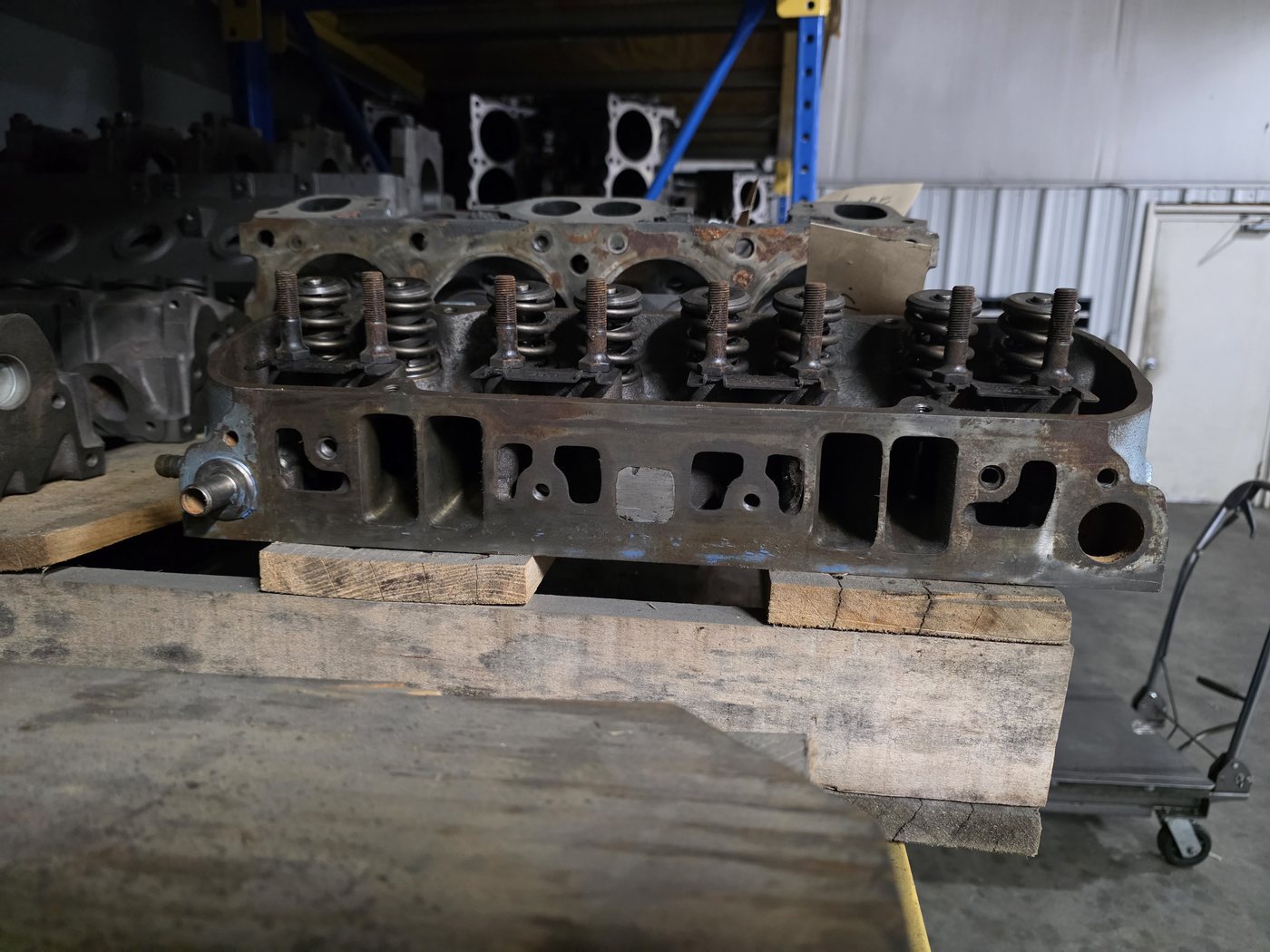
Cast iron head, intake side. The press-in heater hose fitting is at the left end; the intake-side plug locations run along this face.
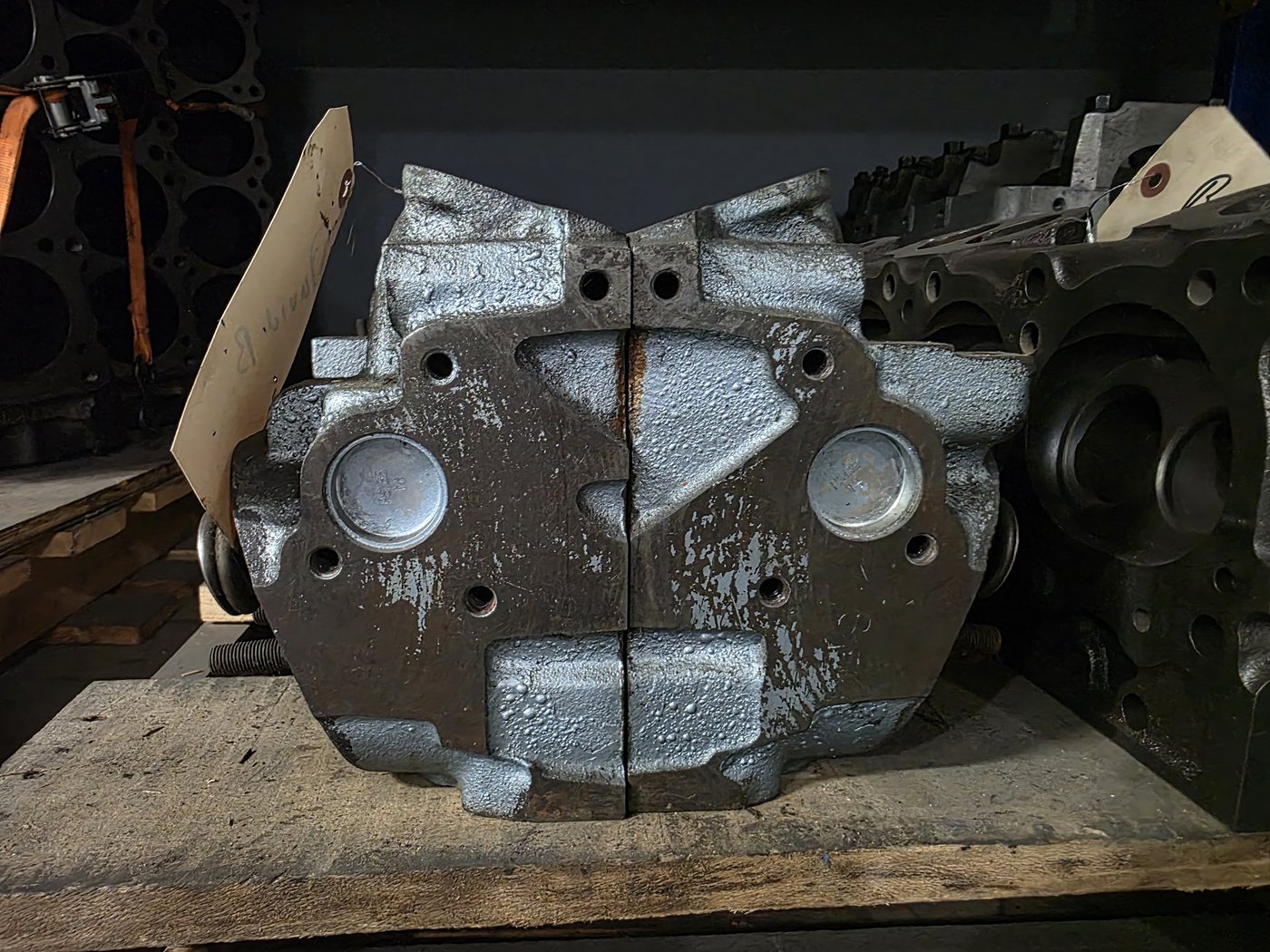
A pair of cast iron heads stood on end. The 1-3/8″ plug in the end of each head is PIO-EPC80B — the one that gets forgotten when the plug order goes in.
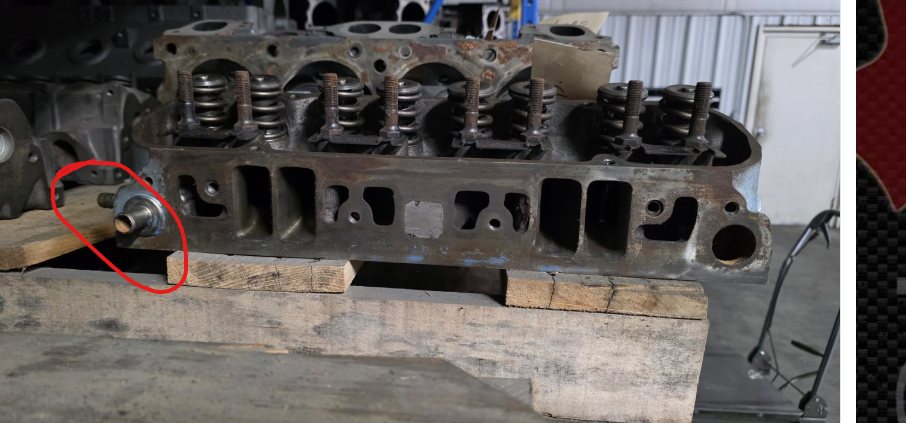
The press-in heater hose fitting, circled — AAU-P132N, 1965-and-later original style, passenger side rear of the head. It presses into the head the same way a plug does, and the brass head plug kit does not include it.
| BPI-Block-Plug-Kit-Factory | Butler Ultimate Pontiac Block Plug Kit. Contains the drilled block plug that sits inside the block behind the distributor, the Butler pipe plug install tool, the press-in front galley plugs, and two optional 3/8″ threaded plugs for the front of the block in place of the press-ins. |
| MEL-MPE115BR | Melling Pontiac brass block kit: eight 1-61/64″ brass plugs, one 2-1/16″ steel cam plug, one 15/16″ steel plug, two 9/16″ steel plugs, two 3/8″ steel pipe plugs. |
| BPI-1030 | Butler pipe plug tool for the PP475 galley plug and the 3/8 hex block plugs. |
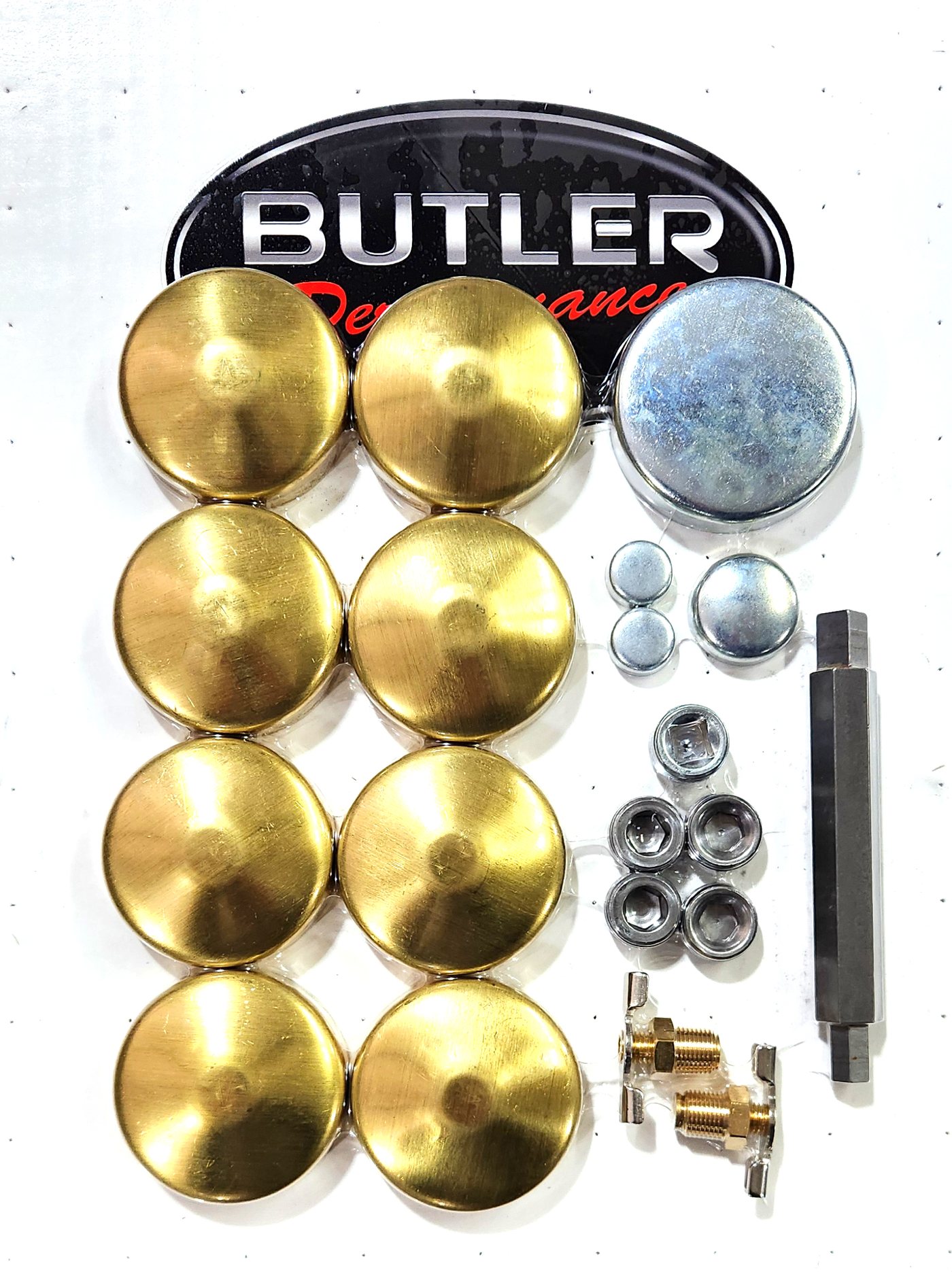
The Butler Ultimate Block Plug Kit laid out: eight brass 1-61/64″ coolant core plugs for the block sides and rear, the 2-1/16″ cam plug, the small press-in galley plugs, the threaded oil galley plugs including the drilled one that goes behind the distributor, two brass drain spigots, and the pipe plug install tool.
| Clean the bore first | A core hole full of rust scale will not seal no matter what you put in it. The hole gets cleaned back to clean iron before the plug goes near it. |
| Sealer on the outside diameter | Every press-in plug — coolant, cam and oil galley. |
| Drive square, on the rim | A driver that contacts the outer edge of the cup. Hitting the center of a cup plug distorts it and it will never seal. |
| Do it on the stand | Rear core plugs, cam plug and the galley plug behind the distributor are all unreachable once the engine is in the car. |
| Match drilled to drilled | If the plug that came out has an orifice in it, the plug that goes back has an orifice in it. |
Not sure which plug you are looking at?
Butler Performance · 2786 Hwy 43 North, Lawrenceburg, TN · 866-762-7527. Send us a photo and the casting number and we will tell you what it takes.