
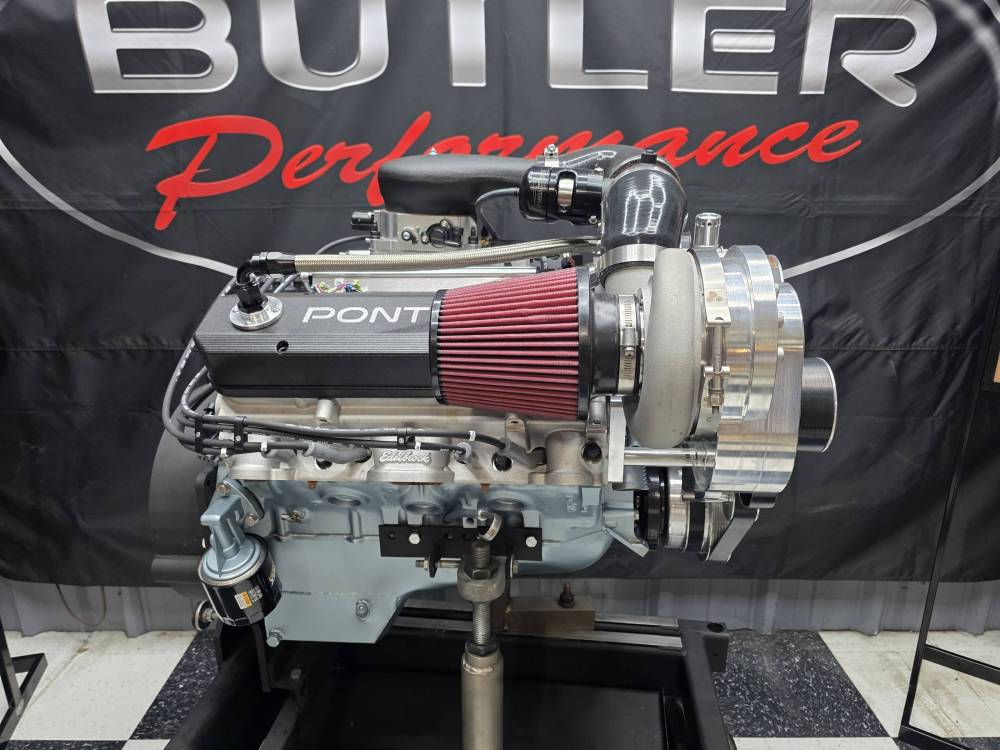
Butler Performance 407ci TorqStorm Supercharged Pontiac Crate Engine — PUMP GAS 708 HP / 671 LB-FT, Dyno Tested
708 HP and 671 lb-ft — Pump Gas, measured on our dyno, not calculated. A Butler-built 407 cubic inch Pontiac with a TorqStorm centrifugal supercharger and Holley Terminator X multi-port EFI, making peak power at 10.4 psi.
Description
708 horsepower and 670 lb-ft — measured, not calculated
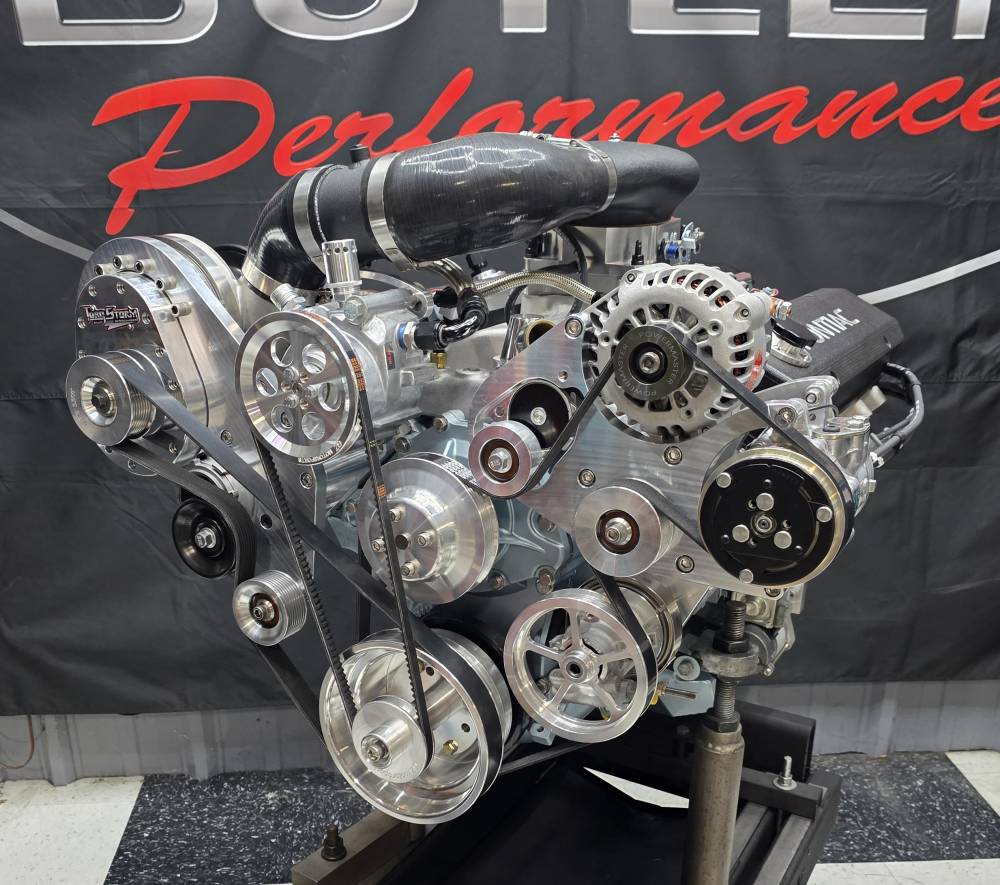
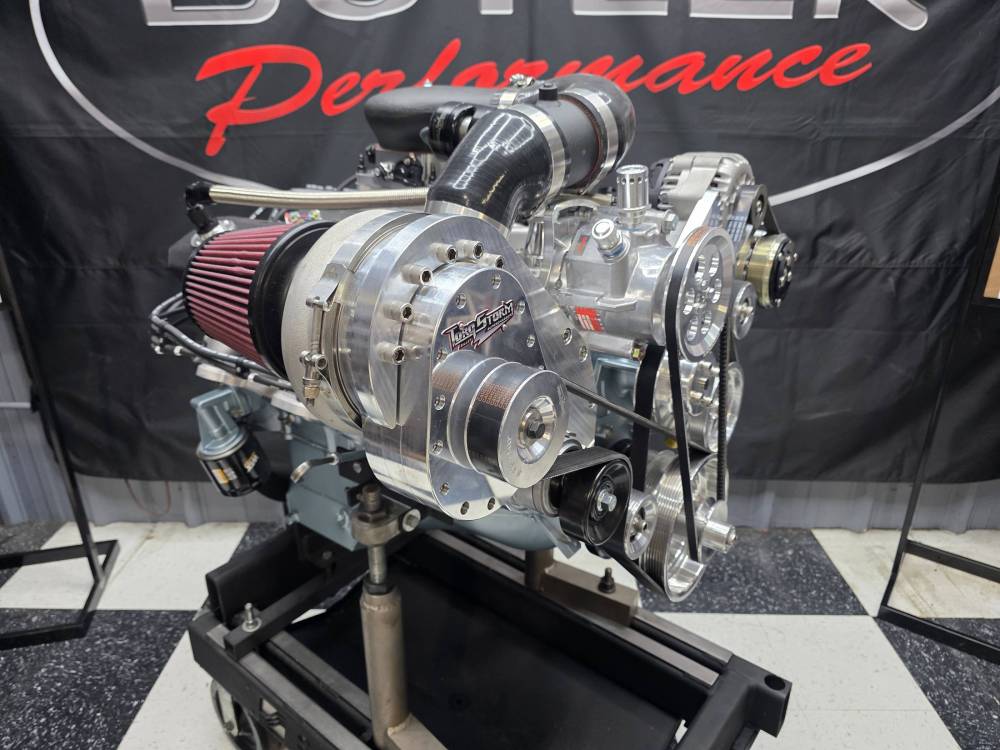
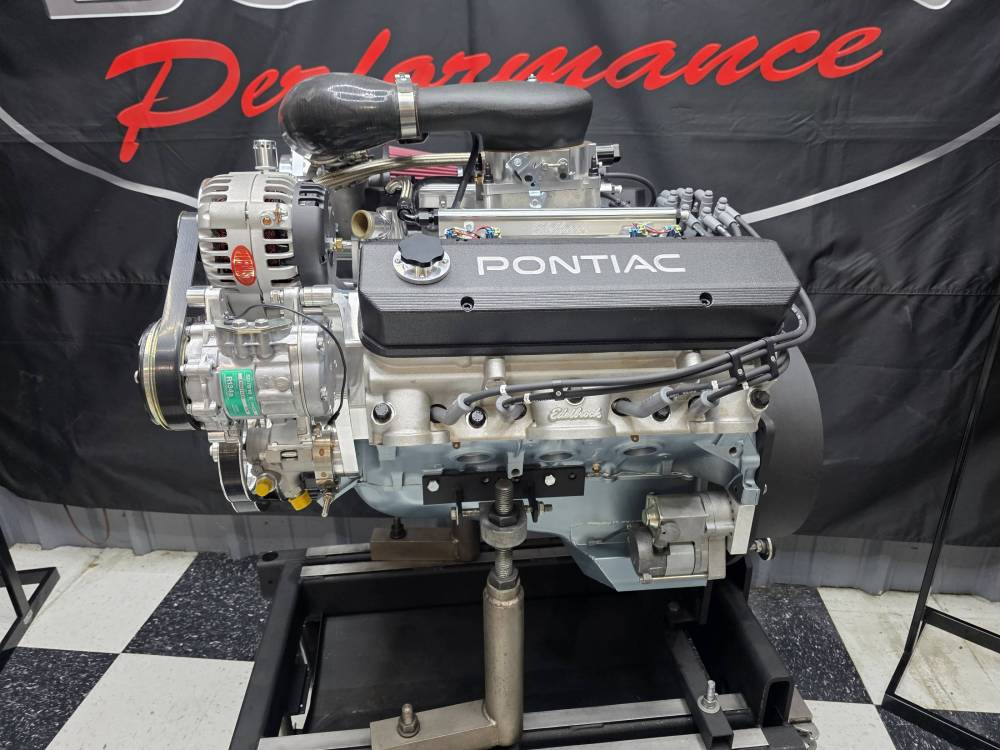
A Butler Performance in-house build: 407 cubic inches of Pontiac V8 under a TorqStorm centrifugal supercharger, fed by Holley Terminator X multi-port EFI. Assembled and blueprinted here in Lawrenceburg, run on our own engine dyno, and the numbers below are what it actually made — corrected, in our cell, on the day.
Torque crosses 600 lb-ft before 3,900 and is still there at 6,100 — a 2,200 rpm band. It peaks at 670 at 4800 and holds 650 or better from 4,400 to 5,400. Horsepower is still within three of peak at 6,300 when the pull ends.
Why the curve matters more than the peak
A centrifugal supercharger builds boost with engine speed, and this combination is set up to use that. Boost comes in at 4.1 psi by 3,700 rpm and climbs steadily to 10.4 psi, so the engine is pulling hard from low in the range rather than waiting for the top of the tacho.
That is a very different engine to drive than a big-inch naturally aspirated combination that signs off early. It pulls hardest exactly where a street car spends its time when you ask something of it.
Built from a 350 block — and that is the interesting part
This started as a Pontiac 350 casting. It was drilled and tapped for four-bolt mains with a Pro-Gram billet front cap and Butler steel centre caps on ARP studs, rebored and honed with a torque plate, square decked, align bored across four caps, align honed, thermal cleaned, magnafluxed and sonic tested before a single part went into it. With a 4.250" Eagle forged crank and a 3.905" bore it comes out at 407 cubic inches.
Most people write the Pontiac 350 off. Prepared properly, this one makes 708 horsepower.
Why 9.5:1
Compression on a boosted engine is a decision, not a leftover. TorqStorm's own guidance for this kit is 9.8:1 maximum on aluminium heads, and for 93 octane pump gas they suggest 8.75–9.5:1 depending on pulley size and boost level. This engine sits at the top of that window — 9.5:1 on aluminium Edelbrock heads, with Butler forged pistons carrying a −16cc dish and a .040" Cometic MLS gasket getting it there.
That is why it takes 10.4 psi without living on the edge of detonation. Build the same engine at 10.5:1 and the blower becomes a liability instead of an asset. The camshaft follows the same logic: a Butler/Comp Power Adder grind, 236/244 duration at .050" on a 114 lobe separation, which keeps cylinder pressure sensible under boost and gives the blower something to work with.
The supercharger package
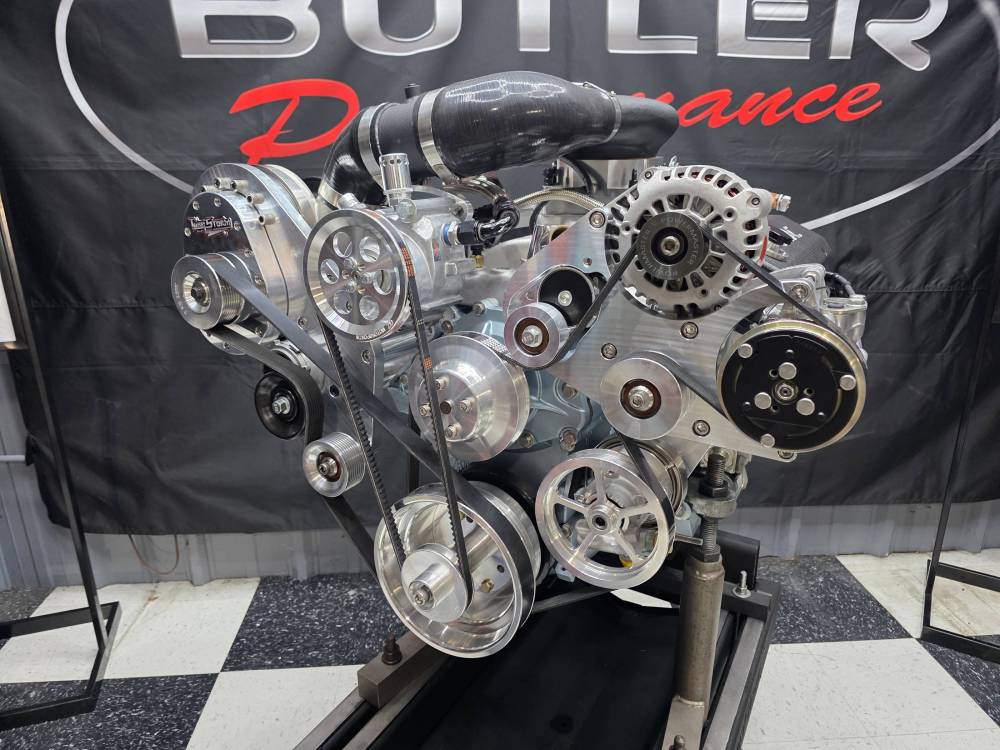
This is the TorqStorm Plus serpentine system for the Pontiac 326-455, passenger-side mount. It is a complete system rather than a charger and a bracket:
- Keeps your accessories. The serpentine layout drives air conditioning, power steering and the alternator alongside the blower — you are not giving up A/C to run boost.
- Everything to install it. Supercharger, brackets, pulleys, hoses, tubes, blow-off valve and hardware.
- Limited lifetime warranty on the supercharger.
- A bung for water/methanol injection is provided if you want to go further later.
Pulley size is the boost lever. As dyno tested this combination produced 4.1 psi at 3,700 rpm rising to 10.4 psi at the top of the pull. A smaller pulley spins the blower faster and makes more boost; that is a conversation to have with our tech department alongside compression and fuel, not a part to change on its own.
Crankcase evacuation — the part nobody photographs
A boosted engine puts more pressure past the rings than a naturally aspirated one, and that pressure has to go somewhere. This build runs a GZ Motorsports Super Pro billet vacuum pump off the crank mandrel, with a breather tank, a billet hi-flow control valve and a Butler billet evac baffle in the valve cover.
Pulling the crankcase into vacuum improves ring seal, keeps oil where it belongs and stops pressure finding its own way out through a gasket. It is not a glamorous line on a spec sheet, and it is one of the reasons this engine made the numbers it did without drama.
Specification — as built
| Block | Pontiac 350 core, converted to 4-bolt main, sonic tested |
|---|---|
| Main caps | Pro-Gram billet front, Butler steel 4-bolt centers, ARP 194-5601 studs |
| Block machining | Rebored & honed w/ torque plate, square decked, align bored, align honed |
| Displacement | 407 ci — 3.905" bore × 4.250" stroke |
| Crankshaft | Eagle 4340 forged, 4.250" stroke, 3" main, 2.200" BBC rod journal |
| Connecting rods | Molnar 4340 forged Power Adder H-beam, 6.800", ARP2000 |
| Pistons | Butler forged, 1.295" CH, custom dish, −16cc |
| Rings | DSS XP600 — stainless top, Napier second |
| Bearings | Clevite 77 full-groove mains, Federal Mogul BBC race rod bearings |
| Compression | 9.5:1 |
| Camshaft | Butler/Comp BP9010 Power Adder hyd roller — 236/244 @ .050", .360"/.380" lobe lift, 114 LSA |
| Lifters | Comp cartridge-style hydraulic roller |
| Rocker arms | Butler 1.5 Tru-Ratio Endurance Series roller |
| Pushrods | Smith Bros 2-piece chromemoly, oil restricted, 8.800" |
| Cylinder heads | Butler 72cc Edelbrock D-port, CNC ported 310+ CFM, titanium retainers |
| Head gaskets | Cometic MLS .040", 4.100" chamfered bore — Butler Spec |
| Intake | Edelbrock Torker II for EFI, port matched to the heads |
| Supercharger | TorqStorm Plus serpentine kit w/ AC-PS-ALT, passenger side mount |
| Fuel injection | Holley Terminator X MPFI, 1000 CFM billet throttle body, DeatschWerks 948cc injectors |
| Ignition | Holley EFI dual-sync billet distributor, HyperSpark coil & CD box, MSD 8.5mm wires |
| Oiling | Butler PRO 80 psi pump, hardened drive shaft, Canton 7-8 qt pan |
| Crankcase | GZ Motorsports Super Pro billet vacuum pump, breather tank, control valve |
| Damper | Powerbond, SFI approved |
| Cooling | FlowKooler 11-bolt hi-volume alloy pump, 180° thermostat |
| Valve covers | Butler billet, CNC engraved, black |
| RPM | HP | LB-FT | PSI | AFR |
|---|---|---|---|---|
| 3800 | 432.9 | 598.3 | 4.1 | 12.5 |
| 4000 | 472.0 | 619.7 | 4.2 | 12.5 |
| 4200 | 512.4 | 640.8 | 4.6 | 12.5 |
| 4400 | 550.5 | 657.1 | 5.1 | 12.5 |
| 4600 | 584.9 | 667.9 | 5.6 | 12.6 |
| 4800 | 612.8 | 670.5 | 6.1 | 12.5 |
| 5000 | 634.9 | 667.0 | 6.6 | 12.3 |
| 5200 | 654.7 | 661.3 | 7.1 | 12.2 |
| 5400 | 671.7 | 653.3 | 7.7 | 12.1 |
| 5600 | 686.1 | 643.4 | 8.3 | 12.1 |
| 5800 | 697.9 | 632.0 | 9.0 | 12.0 |
| 6000 | 707.4 | 619.2 | 9.5 | 12.0 |
| 6200 | 707.4 | 599.2 | 10.1 | 12.0 |
| Correction | STP + inertia |
|---|---|
| STP factor | 1.063 |
| Barometer | 29.22 inHg |
| Air temp | 82°F |
| Humidity | 44% RH |
Built the Butler way
Butler has been building Pontiac engines since 1974. Every engine that leaves here is assembled and blueprinted in our own shop and run on our own dyno before it ships — we don't ship an engine we haven't heard run. The dyno sheet goes with it.
Boosted Pontiac combinations are not a parts-list exercise. Compression, camshaft, fuel system and ignition all have to be chosen around the boost level, and getting one of them wrong is expensive. If you're considering a supercharged build, talk to our tech department before you buy parts.
Details
- BP114618-ENG
- BP114618-ENG
- Butler Performance
- New
Shipping Information
- Item Requires Shipping
- $650.00
- This item will require a special quote for shipping charges.
Customer Reviews
 Total Reviews (0)
You must login to post a review.
Write the First Review!